
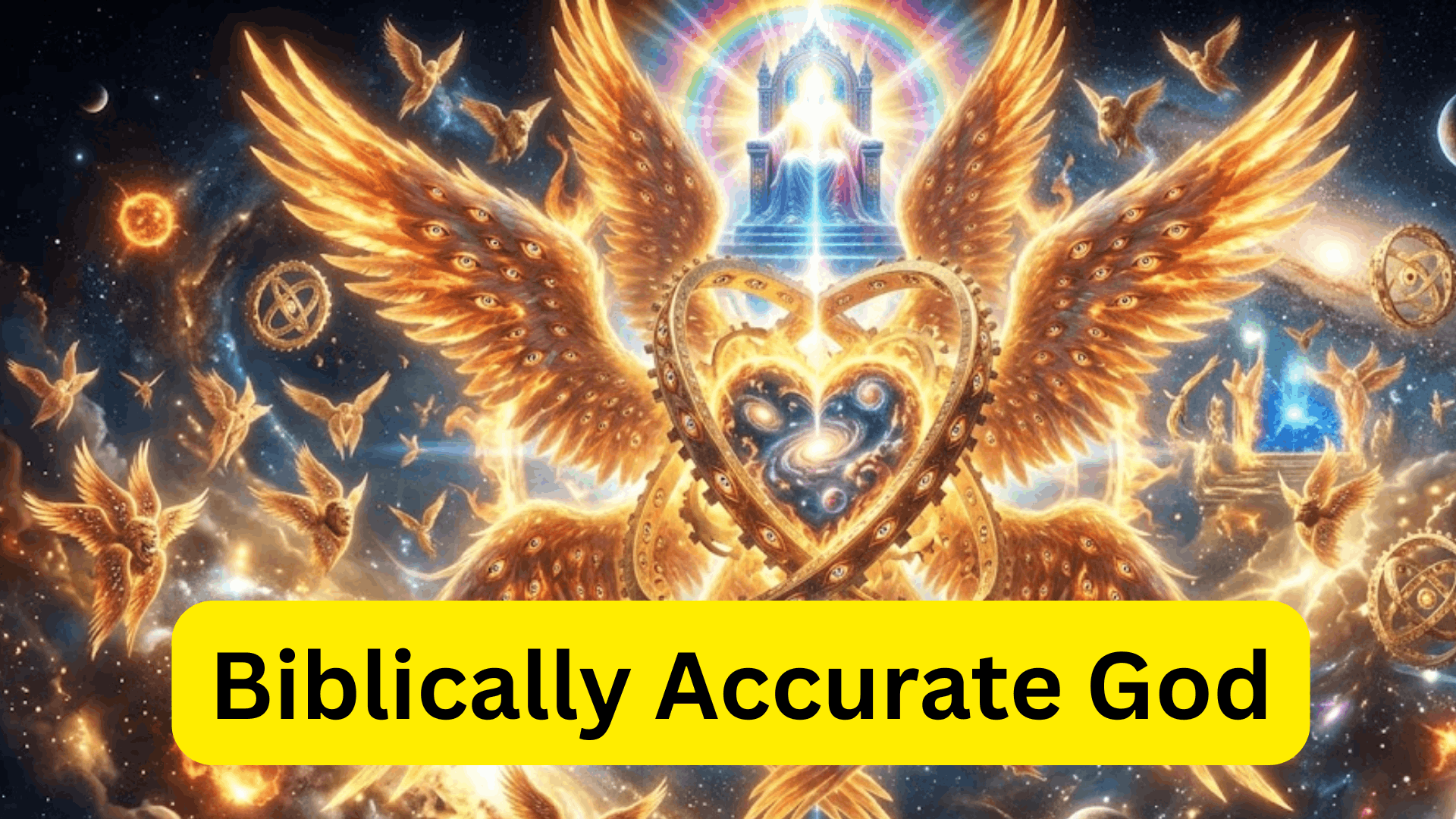
I remember sitting in a church basement as a kid, staring at a felt-board cutout of God as a kind old man with a white beard, floating on a cloud. Nobody questioned it. It was just what God looked like, the same way Santa had a red suit. Years later, reading Ezekiel for the first time on my own, I nearly laughed out loud—not because it was funny, but because it was so strange it didn’t fit any image I’d ever been handed. That’s the gap this article sits in.
A biblically accurate God, the version actually described in scripture rather than in Sunday school art, is stranger, more overwhelming, and honestly more interesting than most of us were ever taught. This isn’t about debunking faith or being edgy for clicks. It’s about actually reading the text and taking it seriously, even when it makes us uncomfortable.
Part of what makes this topic worth sitting with is how quietly the substitution happened. Nobody sat down and decided to swap out scripture’s actual imagery for a kindly grandfather on a cloud.
It built up slowly, generation after generation, through art, then through picture books, then through cartoons, until the substitute became so familiar that the original text started to feel like the strange version instead of the other way around. That’s worth noticing before we even get into the specific passages.
What “Biblically Accurate” Actually Means
The phrase “biblically accurate” started as internet shorthand, mostly attached to angels, but it applies just as well to descriptions of God’s glory and presence. It means going back to the actual Hebrew and Greek texts instead of relying on centuries of religious art, which was often shaped more by available materials and cultural taste than by scripture itself.
Here’s the thing people miss: most classical depictions of God—Michelangelo’s outstretched hand, medieval manuscripts with a bearded figure on a throne—were never meant to be literal. Artists were working within visual traditions, translating an idea into something a congregation could look at without feeling lost. That’s a legitimate artistic choice. It’s just not what the text says.
When scripture does describe an encounter with God directly, the language shifts into something closer to poetry mixed with sensory overload. Moses can’t look at God’s face and live (Exodus 33:20). Isaiah sees the hem of a robe filling a temple, with six-winged creatures screaming “holy” until the doorposts shake (Isaiah 6:1-4). This matters because it tells us something real about how the biblical writers understood divine presence: not comfortable, not familiar, not something you casually picture in your head.
It’s also worth being clear about what “biblically accurate” doesn’t mean here. It doesn’t mean scripture hands us a tidy blueprint we can hand to an illustrator. If anything, the opposite is true—the more directly a passage tries to describe God’s actual appearance, the more it seems to retreat into comparison and qualification. That retreat is itself part of the accurate picture. A truly faithful rendering has to include the hedging, not just the imagery.
Also Read This: Tristan Name Meaning Bible: A Spiritual and Biblical Insight
The Throne Room Visions: Ezekiel, Isaiah, and Revelation
This is where a biblically accurate God gets genuinely wild, and it’s worth slowing down here because most people have never actually read these passages start to finish.
Ezekiel chapter 1 describes four living creatures, each with four faces and four wings, moving alongside wheels that are described as “a wheel within a wheel,” their rims covered in eyes. Above all this is a platform, and above the platform, a throne, and on the throne, something with the appearance of a man—but even that description is hedged constantly with words like “likeness” and “appearance,” as if Ezekiel is straining to describe something his vocabulary simply can’t hold. He ends the vision by calling it “the appearance of the likeness of the glory of the Lord,” which is about as many hedging words as one sentence can carry.
Isaiah’s version, in chapter 6, gives us seraphim—not winged babies, but six-winged beings who cover their own faces and feet in the presence of God’s glory, calling out so loudly the temple foundations shake and the room fills with smoke.
Revelation 4 combines elements of both, adding a sea of glass “like crystal” before the throne and four living creatures “full of eyes in front and behind.” John, the author, was already an old man who had walked with Jesus in the flesh, and even he describes falling down “as though dead” (Revelation 1:17) at the sight.
None of these are casual, comfortable images. They read like eyewitness accounts straining against the limits of human language, which is exactly what a lot of biblical scholars argue they are.
The Ancient of Days: Daniel’s Vision
There’s a fourth passage that often gets left out of this conversation, even though it’s one of the more specific physical descriptions in the entire Old Testament: Daniel chapter 7.
Daniel describes “the Ancient of Days” taking a seat, clothing “white as snow,” hair “like pure wool,” and a throne that is itself made of fiery flame, with wheels of burning fire. A river of fire flows out from before the throne, and Daniel says thousands upon thousands attend him, with ten thousand times ten thousand standing before him. It’s one of the few places where scripture actually commits to describing hair and clothing in specific terms—and even here, the description immediately escalates into fire, motion, and an audience too vast to count.
What’s interesting is how this vision gets used later. In Revelation 1, John borrows almost identical language—white hair, eyes like flame—to describe the risen Christ, which is its own theological statement worth sitting with, but outside the scope of what this article is trying to cover. For our purposes, the key point is simpler: even scripture’s most “human-shaped” description of a divine figure is still wrapped in fire, motion, and scale that resists any comfortable mental picture.
Why the Language Itself Feels So Strained
It’s worth pausing on something easy to skim past: the grammar of these passages. Ezekiel doesn’t say “I saw a man.” He says he saw “the appearance of the likeness of the glory of the LORD.” That’s four layers of hedging stacked on top of each other in a single phrase. Isaiah doesn’t describe God’s face; he describes the hem of a robe and lets the reader infer the rest. Daniel gives specific details—snow-white clothing, wool-white hair—but immediately buries them under fire and a crowd too large to count.
This pattern isn’t an accident of translation. Scholars who work in Hebrew apocalyptic and prophetic literature point out that this kind of layered, comparative language is a recognized feature of the genre, not a stylistic quirk of any one author.
Writers reaching for something beyond ordinary experience default to simile stacked on simile—”like,” “as,” “the appearance of”—because flat description would claim a precision the experience itself didn’t have. In other words, the vagueness isn’t a failure to communicate. It’s the most honest communication available for something this far outside ordinary human categories.
That’s a useful thing to hold onto, because it reframes the whole project of “picturing” these scenes. The goal was never to hand future readers a photograph. The goal was to convey scale, intensity, and otherness using the only tools language has for something that outstrips direct description.
Why Popular Imagery Got It So Wrong
It’s worth asking why the felt-board version stuck around for so long, because the answer isn’t laziness—it’s function.
Medieval and Renaissance art needed to communicate theological ideas to largely illiterate populations. A kind, fatherly figure on a throne communicated authority and care in a single glance. It worked as visual shorthand. The problem is that shorthand calcified into assumption, and assumption became the default mental image passed down through hundreds of years of paintings, stained glass, and eventually children’s Bibles.
There’s also a simpler reason: the actual text is hard to draw. How do you paint a wheel covered in eyes without it looking like a horror movie prop? How do you render “the appearance of the likeness of the glory of the Lord” in a way that doesn’t just look like fog? Artists made choices that were paintable, not necessarily accurate. A youth pastor showing a kid a picture of an old man on a cloud is choosing legibility over fidelity, and there’s nothing malicious in that—but it does mean generations grew up with an image scripture never actually presents.
It also helps to remember that different traditions handled this problem differently. Eastern Orthodox iconography, for instance, has historically been far more cautious about depicting God the Father directly, leaning instead on symbolic representations—a hand emerging from clouds, light, or an empty throne prepared for judgment—precisely because of concerns about reducing the infinite to a paintable figure. Western religious art took a more direct route, and that route is the one that ended up shaping most of the popular imagination in English-speaking Christianity. Neither approach is scripture itself; both are interpretive traditions responding to the same underlying problem.
This is also where the whole “biblically accurate angels” meme trend online actually did something useful, even if it started as a joke. It sent a lot of people back to Ezekiel and Isaiah for the first time in their adult lives, and that’s a real shift, not just internet humor.
The Angels Guarding God’s Presence Aren’t Cute
Since the imagery of angels is so tightly wound up with how people picture God’s throne room, it’s worth pulling apart on its own.
Cherubim in Genesis 3:24 are stationed with a flaming sword to guard the entrance to Eden—not exactly the chubby infant look painted on Valentine’s Day cards. Ezekiel’s cherubim have four faces each: human, lion, ox, and eagle. Seraphim, the six-winged beings in Isaiah, are named from a Hebrew root associated with burning. Their whole physical description is built around fire and covering—wings shielding their own faces from the glory in front of them.
The point isn’t to make these beings sound like monsters for shock value. The point is that their entire visual design, as scripture presents it, exists to communicate something about the overwhelming nature of what they’re standing next to. If the guardians of God’s presence are described as too intense to look at directly, that tells you something about the presence itself. It’s a detail that gets lost completely once you replace it with a soft-focus painting of two toddlers with wings.
It’s also worth noting that these beings aren’t decorative in the text. Their four faces, their wings, their eyes—each detail tends to correspond to a function: watchfulness, speed, strength, service. Nothing about their design reads as ornamental. Everything about it reads as purposeful, which is a very different design philosophy than “make it pretty enough for a nursery wall.”
How to Use / Practical Tips
If you want to actually engage with a biblically accurate God rather than just read about the idea secondhand, here’s how to do it in a way that’s genuinely useful, not just interesting trivia.
- Read the primary texts yourself, slowly. Open Ezekiel 1, Isaiah 6, Daniel 7, and Revelation 4 in a translation you don’t normally use—try the ESV if you usually read NIV, or vice versa. Reading the same passage in unfamiliar phrasing forces your brain to actually process the words instead of skimming a memorized rhythm.
- Keep a running list of sensory details as you read. Note every color, sound, and physical description mentioned. You’ll notice how much of the text is built around things being “like” something else—”like the sound of many waters,” “like burning coals”—rather than flat statements. That comparative language is doing real theological work.
- Cross-reference the visions against each other. Put Ezekiel 1, Isaiah 6, Daniel 7, and Revelation 4 side by side. The overlaps—four living creatures, wings, eyes, fire—aren’t coincidental, and noticing the pattern will teach you more than reading any single passage in isolation.
- Separate art history from theology in your own head. Next time you see classic religious art, ask yourself: is this artist depicting scripture literally, or communicating a feeling through symbol? Both are valid, but conflating them is where most people’s mental image gets skewed.
- Use a study Bible or commentary for the hard parts. Ezekiel’s wheel imagery in particular has been debated by scholars for centuries. A decent study Bible will walk you through the main interpretive options instead of leaving you to guess.
- Pay attention to what the human witnesses do, not just what they see. Isaiah says “woe is me.” Ezekiel falls on his face. John collapses “as though dead.” Daniel describes his own strength draining away. The reactions of the people receiving these visions are as much a part of the description as the visions themselves, and they’re easy to skip past if you’re only hunting for imagery.
- Notice the recurring numbers. Four faces, six wings, seven spirits, twenty-four elders—numerical patterns show up constantly in these texts and often carry symbolic weight (completeness, totality, order) rather than being arbitrary counts. Tracking them across passages adds another layer to the cross-referencing exercise above.
My Honest Take
I’ll be straight with you: I don’t think the goal here is to throw out every piece of traditional religious art, and I get a little wary when people frame this topic as “gotcha, the church lied to you.” Symbolic art has value. A stained-glass window doesn’t need to be a documentary.
That said, I do think something got lost along the way, and it’s worth reclaiming. When you actually sit with Ezekiel’s vision or Isaiah’s temple scene, there’s a weight to it that a felt-board cutout never gave me as a kid. It’s less comforting and more, frankly, unsettling—but unsettling in a way that feels closer to what the original writers were actually trying to convey. I’m not sure every reader needs to go full “biblically accurate everything,” but ignoring the actual descriptions entirely feels like missing the point of the text.
If anything, I’ve come to think the discomfort is the point rather than a side effect of it. A God who fits comfortably into a felt-board cutout is a God who’s been made manageable, and these passages seem specifically designed to resist that. They’re not trying to give you something you can fully picture. They’re trying to give you something you can only partially picture, and then let the gap between the vision and your imagination do some of the theological work on its own.
FAQs
What does the Bible actually say God looks like?
Scripture rarely gives a direct physical description of God himself. Instead, writers describe overwhelming glory, fire, light, and surrounding beings, often using hedged language like “likeness” or “appearance of.” Moses and Isaiah both describe being unable to view God directly, only his glory or the hem of his robe.
Are biblically accurate angels really covered in eyes?
Yes, specifically the four living creatures in Ezekiel 1 and 10, and again in Revelation 4, are described with wheels and bodies “full of eyes.” This detail symbolizes complete awareness and watchfulness rather than being a random or decorative image.
Why do cherubim in the Bible look different from paintings?
Renaissance and medieval art depicted cherubim as small, winged children for visual and cultural reasons, not textual accuracy. Genesis and Ezekiel describe cherubim as powerful guardian beings with multiple faces, closer to Ezekiel’s four-faced creatures than to any cherub found on a greeting card.
Is it disrespectful to talk about what God “looks like”?
Not inherently—scripture itself describes these visions in detail through named prophets. Approaching the topic with genuine curiosity and respect for the text, rather than mockery, keeps it in line with how these passages were originally shared and preserved.
Where in the Bible are the clearest descriptions of God’s glory?
Exodus 33, Isaiah 6, Ezekiel 1 and 10, Daniel 7, and Revelation 4 contain the most detailed throne-room and glory descriptions. Each one uses different imagery, but they consistently point toward something too vast for ordinary human language to fully capture.
Why does God’s appearance change between visions?
It’s less that the appearance changes and more that each writer is describing the same kind of overwhelming encounter from a different angle, using different sensory anchors—fire in Daniel, robes and smoke in Isaiah, wheels and creatures in Ezekiel. Scholars generally read this as evidence that each vision reflects genuine, individual encounter rather than a single copied template, since a manufactured or borrowed account would likely look more uniform across authors.
Closing
Reading these passages for myself changed how I think about the whole idea of divine glory. It’s not a tidy picture you can pin on a wall. It’s something scripture keeps circling around, straining to describe—and that struggle is, honestly, part of the point.

Welcome to Blessings Beam. I’m David, an Unique SEO and Content Writer with 5 years of experience. I help websites rank higher, increase organic traffic, and deliver impactful content that genuinely connects with readers. My goal is to make SEO simple, effective, and results-driven. Let’s achieve more together.