
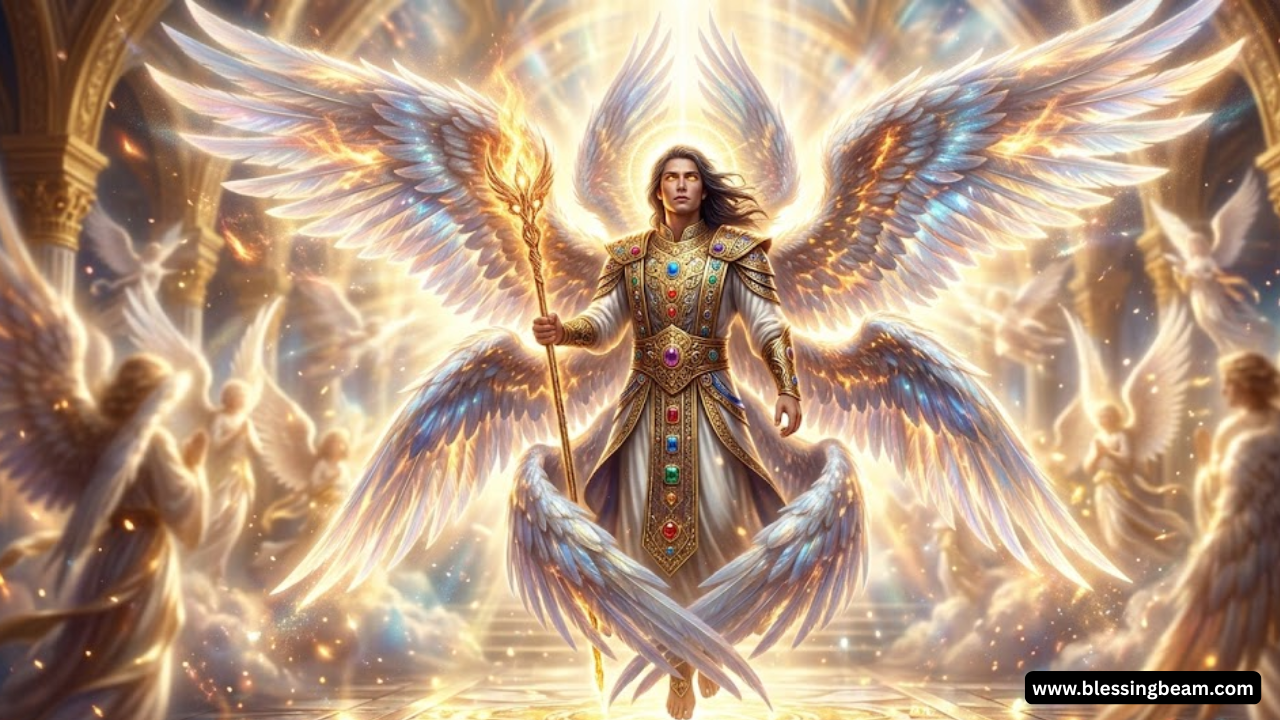
Most people think they already know who Lucifer is. They picture a red devil with horns, ruling hell and causing chaos. But that image has almost nothing to do with what the Bible actually says.
The word “Lucifer” only appears once in the entire Bible, in Isaiah 14:12. It was originally a Latin translation referring to a “shining star” or “son of the dawn.” Most modern scholars agree it was not even written as a direct name for Satan.
The real biblical picture of Lucifer is far more surprising and more sobering than the myths. He was breathtakingly beautiful, incredibly wise, and held one of the highest positions in all of heaven. Understanding who he truly was makes his fall and his ongoing deception much harder to ignore.
Biblically Accurate Understanding of Lucifer’s Identity
Common Misconceptions About Lucifer in Modern Culture
Understanding Lucifer requires careful attention to limited biblical texts, primarily Isaiah 14:12-15 and Ezekiel 28:12-17, while recognizing the significant gap between scriptural description and centuries of artistic and theological interpretation.
Popular culture has shaped a heavily distorted image. Literary works amplified this tradition. Dante’s Inferno (1320) and Milton’s Paradise Lost (1667) presented “Lucifer” as Satan’s pre-fall name so compellingly that the equation embedded itself in popular imagination permanently.
What Scripture Actually Reveals About Lucifer
According to Christian tradition, Satan has a backstory: the devil was once the most beautiful angel in heaven but this angelic being, then called Lucifer, rebelled against God and was cast down to hell.
In part, this tradition comes from a particular interpretation of Isaiah 14:12-15. However, the biblical picture is more layered. Isaiah 14 refers to the king of Babylon, and “Satan” appears nowhere in the passage.
Thus, if we ground our theological understanding on Scripture alone, we have no reason to posit an angelic prehistory for Satan based on Isaiah.
The Hebrew Original (Helel and Its True Meaning)
The text describes someone who, in Isaiah’s original Hebrew, is called Helel ben Shachar (הילל בן שׁחר) variously translated as “Day/Morning Star, son of Dawn/Morning.” The Hebrew term underlying “Lucifer” carries significance often lost in translation.
Helel (הֵילֵל) derives from the root halal, meaning “to shine” or “to boast.” This word appears only once in the entire Hebrew Bible, making Isaiah 14:12 the exclusive scriptural source for this designation.
The complete phrase “Helel ben Shachar” translates as “shining one, son of dawn” or “day star, son of the morning.” Ancient Near Eastern readers would have immediately recognized this as referring to Venus, the morning star that outshines all other celestial bodies.
Jerome’s Latin Vulgate and the Birth of ‘Lucifer’
The word translated as “day star” or “morning star” is the Hebrew term helēl. Many scholars understand helēl as a reference to Venus, sometimes called the “morning star.” So Latin versions such as the Vulgate translated it literally as lucifer, identical to the Latin name for the planet Venus.
Translations such as the KJV follow the lead of Latin versions, though they render the word helēl as the proper name “Lucifer.” Because Jerome’s Vulgate and patristic allegorizing merged, “Lucifer” became embedded in Western Christian imagination as the pre-fall name of Satan, even while many modern scholars and several historical commentators insist the original passage addressed the Babylonian ruler.
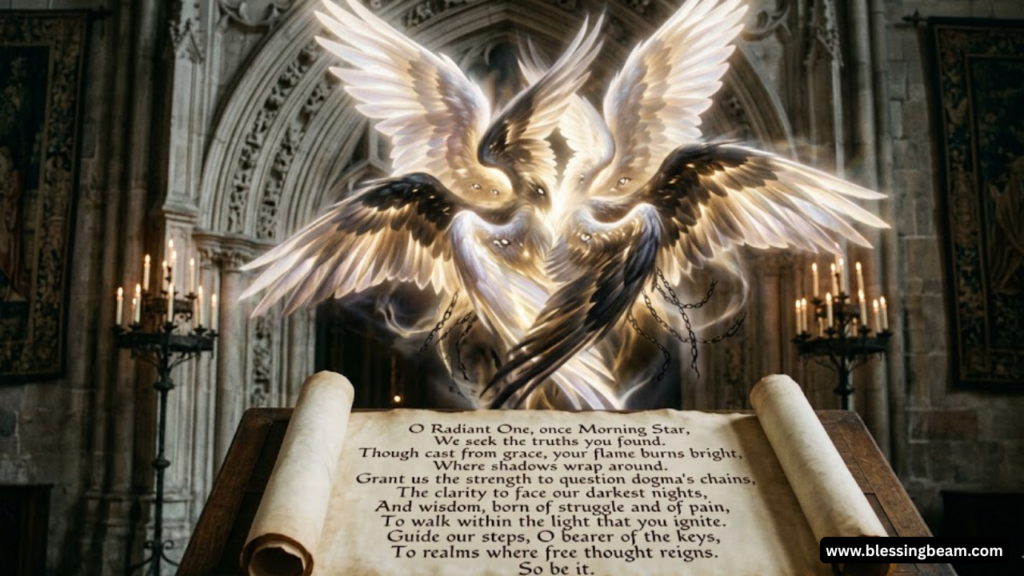
Biblically Accurate Description of Lucifer’s Appearance
Lucifer’s Pre-Fall Glory According to Ezekiel
Ezekiel presents him as “the seal of perfection,” an anointed guardian cherub adorned with nine precious stones, walking among fiery stones on God’s holy mountain. Nine specific precious stones adorned this being: carnelian, topaz, emerald, chrysolite, onyx, jasper, sapphire, turquoise, and beryl, all set in gold.
These gemstones would have created a dazzling display of multi-faceted brilliance, reflecting light in countless directions. He was blameless in his ways from the day he was created. It could not have been otherwise if he stood in God’s presence, then he had to be holy and righteous.
Also Read This: What Is the Biblically Accurate Satan? Exploring His True Role and Appearance in Scripture
The Morning Star Imagery in Isaiah’s Prophecy
Isaiah 14 refers to an earthly king as Lucifer, meaning “bearer of light,” who falls from heaven. Echoing Isaiah’s image, Jesus says in Luke 10:18: “I watched Satan fall from heaven like a flash of lightning.”
Many scholars believe Isaiah was using the Canaanite myths of his time to mock the king of Babylon’s ambitions, alluding to a mythological story about a minor god who tried to take over the mountain of the gods, whose attempted coup failed and who was hurled down to the underworld.
Does Lucifer Possess Physical Form After His Fall?
Scripture provides no description of his post-fall appearance. As a spirit being, he possesses no fixed physical form, though he can manifest variously. Early Christian authors such as St. Augustine regarded the devil as a fallen angel he was bad for having rebelled against God, but retained his angelic substance, and was not a physical being.
When taking a physical form, the devil might choose as undiabolical an aspect as possible: a beautiful woman, for example, or a holy figure the better to deceive his victim.
What Biblical Silence Tells Us Lucifer Is Not
The popular red devil image has no biblical basis, arising from medieval art and theatrical tradition. In the Middle Ages, artists cobbled together imagery from older traditions: “Bits and pieces from lots of now-defunct religions got synthesized: the cloven feet from Pan, the horns from the gods of various cults in the near east.
In the 15th and 16th century, these solidified into this personification of evil: a horned, bestial, furry figure.” None of this has any foundation in Scripture.
Critical Distinction Between Lucifer and Satan in Scripture
Biblical Evidence Supporting Their Distinction
Isaiah 14:12-15 may be an Israelite reworking of an Ugaritic tale called the Baal-Athtar myth, in which a divine underling is punished for attempting to dethrone the reigning Canaanite deity.
While parallels exist between this ancient narrative and Isaiah, neither text mentions “Satan.” The New Testament does offer some connective tissue. In Luke 10:18, Jesus tells his disciples: “I saw Satan fall like lightning from heaven.” That statement, combined with the imagery in Revelation 12 and the language of Isaiah 14, forms the basis for the traditional identification. But it’s a theological construction built across multiple texts, not a single clear verse.
How Christian Tradition Merged These Figures
The Lucifer-Satan identification developed gradually through interpretation. Origen of Alexandria (c. 185-254) stands among the first to allegorize Isaiah 14:12. He argued the language transcended human kings and described Satan’s fall from heaven.
Medieval theology solidified this interpretation, weaving Isaiah 14, Ezekiel 28, and Revelation 12:7-9 into a unified narrative of angelic rebellion. The King James Bible’s retention of “Lucifer” as a proper name made the identification seem biblically explicit, despite the Hebrew’s different implications.
Protestant Reformers’ Rejection of the Equation
John Calvin wrote regarding Isaiah 14:12: “The exposition of this passage, which some have given, as if it referred to Satan, has arisen from ignorance: for the context plainly shows these statements must be understood in reference to the king of the Babylonians.” Martin Luther similarly considered it “a gross error to refer this verse to the Devil.”
These reformers, committed to grammatical-historical interpretation, recognized that Isaiah 14:16 explicitly asks, “Is this the man who made the earth tremble?” indicating the passage addresses a human ruler using cosmic imagery to amplify the dramatic reversal of his pride.
Why This Theological Distinction Matters Today
His pride, taking credit for God-given beauty and wisdom, serves as a universal warning against self-exaltation. His story reminds humanity that all created beings depend on their Creator, and attempting independence from God leads to catastrophe.
Getting the identity of Lucifer right also prevents building an entire demonology on misread poetry. When prophecy aimed at a human king gets transformed into a cosmic biography of Satan, it blurs the line between inspired Scripture and theological tradition.
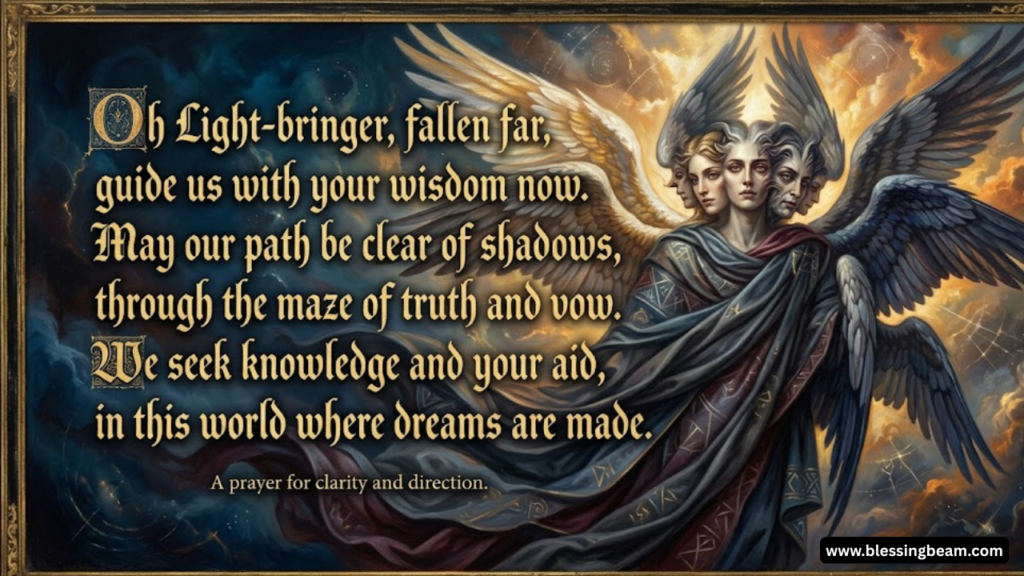
Biblically Accurate Account of Lucifer’s Fall and Significance
The Narrative of the Fallen Angel in Scripture
Scripture presents Lucifer’s story as a progression from perfection to corruption. Ezekiel 28:12 establishes his original state as “the seal of perfection, full of wisdom and perfect in beauty,” an anointed guardian cherub positioned on God’s holy mountain.
The text emphasizes that he “was perfect in ways from the day of creation,” indicating flawless moral character and complete alignment with divine will. The turning point arrives with the phrase “until unrighteousness was found in you” from Ezekiel 28:15, marking the moment when iniquity arose within a being created in perfection a corruption that emerged internally rather than through external temptation.
Lucifer’s Five ‘I Will’ Declarations of Pride
Isaiah 14:13–14 outlines five “I wills” that encapsulate Lucifer’s heart. These declarations portray an angelic insurrection against divine authority. Lucifer wanted to usurp God, not merely oppose Him. The five declarations are: “I will ascend into heaven,” “I will exalt my throne above the stars of God,” “I will sit also upon the mount of the congregation,” “I will ascend above the heights of the clouds,” and “I will be like the Most High.” The very first statement shows his pride “I will ascend into heaven” coming from his heart, from the innermost part of who and what he was.
The Nature of Sin (Pride in God-Given Perfection)
Ezekiel 28:17 says, “Your heart was lifted up because of your beauty; you corrupted your wisdom by reason of your splendor.” Once he focused on his own beauty and wisdom rather than the source of those gifts, he became corrupted.
He thought more of himself than of God, who gave and maintained such powers. This is the profound theological insight of the narrative evil did not come from outside, but arose from within a perfect being through the act of redirecting worship from the Creator to himself.
Catastrophic Consequences of Angelic Rebellion
Ezekiel 28:16 describes his expulsion: “I have cast you as profane out of God’s mountain. I have destroyed you, covering cherub, from the middle of the stones of fire.” After the devil’s delusion about himself, the Lord cast Lucifer out of God’s glorious presence.
He no longer reflected God’s glory but instead sought to have others worship him. What began as radiance became darkness, and what began as worship became opposition.
Artistic Evolution of Lucifer’s Image Throughout History
Early Medieval Period (The Ethereal Blue Angel)
The oldest representation of the Christian idea of the devil may be the mosaic in the Basilica of Sant’Apollinare Nuovo, Ravenna, Italy. The sixth-century mosaic shows Jesus Christ seated at the Last Judgment, separating the souls of the saved from the souls of the damned.
Behind the damned is a blue angel. Both angels wear halos. The blue figure may be Lucifer, the fallen angel later known as Satan. Unlike later depictions, he is beautiful and radiant — not the horned, hoofed, red monster of later depictions.
High Medieval Transformation to Grotesque Forms
Medieval demons were often depicted as animal hybrids or chimeras with hairy bodies, bird legs, wings, or hooves. Many images also showed demons with secondary faces in unusual locations.
According to medieval Christians, Lucifer and his demonic followers were fallen angels. As such, their bodies were a perversion of angelic perfection. Instead of angel wings, they grew the leathery wings of bats, visually underscoring the evil of Satan even though his body was an affront to nature.
In the 15th and 16th centuries, these features solidified into a horned, bestial, furry figure seen as the great enemy of Christ, the Church, and mankind.
Renaissance Romanticization( Milton’s Tragic Rebel)
In the 17th century, John Milton wrote Paradise Lost where Satan was described rather differently. Instead of the horrifying ugly creature, the Devil was portrayed as the most beautiful of all God’s angels, less of an ugly demon and more of a heroic military leader.
Satan was depicted as a chiseled, handsome, young man. William Blake’s 1805 watercolor depiction of Lucifer before his fall reveals the beauty and perfection of the Angel Lucifer resplendent and celestial, with tiny moons and stars dancing at his feet and miniature angels heralding his approach.
Victorian Era Through Modern (The Theatrical Red Devil)
In the 19th century, the publication of Goethe’s Mephistopheles in Faust and Mark Twain’s Mysterious Stranger influenced artists to portray Satan as “a sly, cunning, dandyish type of figure. Instead of scaring people into sin and intimidating them, he now uses persuasion.” The image of the beautiful Satan remained popular throughout the 18th and 19th centuries.
Inspired by Paradise Lost, painter William Blake depicted Satan as a Godlike creature whose features are completely human. Today, the theatrical red horned figure persists alongside portrayals of a charming, wealthy, sophisticated devil in film and television.
Contrasts Between Artistic and Biblical Portrayals
Though modern biblical scholars hold that Satan is a spiritual being with no physical form, artistic renderings of the devil are abundant and vary wildly over the course of history.
The prince of darkness has been repeatedly depicted as a snake, a dragon, all manner of horned beasts with cloven hooves, and more rarely, something beautiful. Every artistic era has projected its own fears, philosophy, and moral concerns onto Lucifer which is precisely why the biblical text itself, sparse and disciplined as it is, remains the only reliable guide.
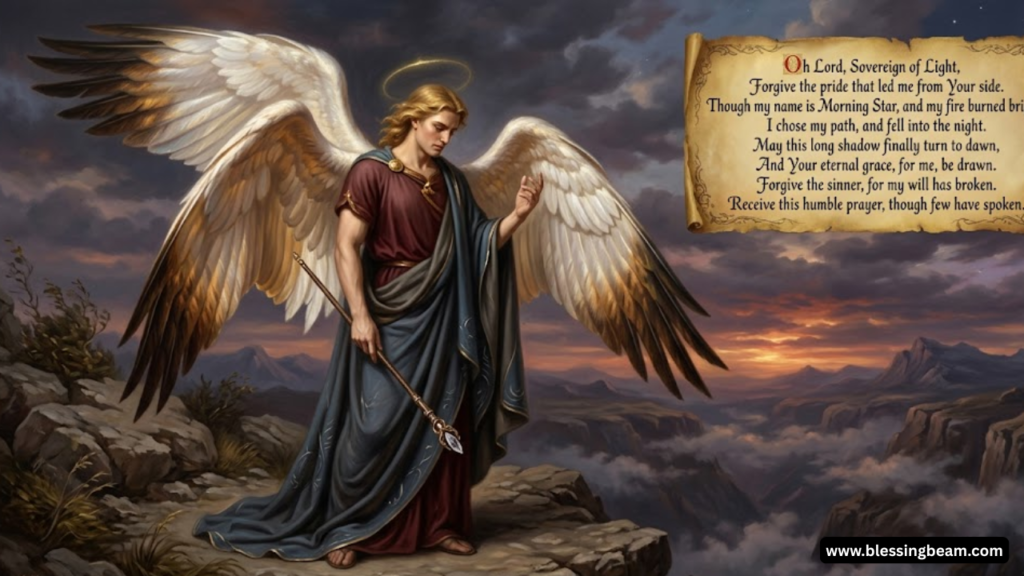
Theological Insights from a Biblically Accurate Lucifer
The Paradox of Created Perfection and Free Will
The idea that Lucifer was a cherub, one of the highest orders of angelic beings stems from a complex prophecy in the Old Testament. The profound and detailed description of this “anointed cherub” in Ezekiel 28 offers a compelling glimpse into his once-exalted state, characterized by unparalleled beauty, wisdom, and close proximity to the divine.
This rich imagery lays the groundwork for understanding the gravity of his subsequent transgression. The paradox is this: God created a being of absolute perfection, yet that same being chose corruption. This tells us that even perfection does not guarantee obedience when the will is free.
The Origin of Evil Within a Perfect Being
The turning point arrives with the phrase “until unrighteousness was found in you” from Ezekiel 28:15. This marks the moment when iniquity arose within a being created in perfection a corruption that emerged internally rather than through external temptation.
The significance of his fall extends far beyond a historical or mythological event; it serves as a cornerstone of Christian demonology and a powerful cautionary tale. Lucifer’s trajectory from heavenly glory to ultimate damnation highlights critical theological concepts such as the consequences of defying divine will.
Evil, Scripture shows, is not a force that God created, it is what happens when a created will turns away from the source of all goodness.
Is Lucifer a Fallen Angel?
Before his rebellion, Lucifer was understood to be a magnificent and exalted angelic being, possibly among the highest of the created order. He was blameless in his ways until iniquity was found in him (Ezekiel 28:15), suggesting that his fall was not a result of external corruption but arose from his own pride and desire for power. Before his fall, Satan was indeed a beautiful creature (Ezekiel 28:12-13). He was perhaps the most beautiful and powerful of all the angels.
The phrase “guardian cherub” possibly indicates that Satan was the angel who “guarded” God’s throne. So yes Scripture consistently portrays this figure as a created angelic being who fell, though the precise identification of “Lucifer” with Satan remains a matter of theological debate among scholars.
Who Is Lucifer in the Bible?
“Lucifer” appears only once in the King James Bible, translating the Hebrew “Helel” (shining one), in a passage addressing the King of Babylon using cosmic imagery. The prophet does not disclose the origin of evil.
Instead, Isaiah 14 refers to the king of Babylon. “Satan” appears nowhere in the passage. Over time, through early Church Fathers, the Latin Vulgate, and centuries of theological tradition, the word became attached to Satan as his pre-fall name. Protestant Reformers John Calvin and Martin Luther explicitly rejected the equation, arguing Isaiah 14 refers to a human king using cosmic metaphor.
Lucifer in the Bible is, at his textual core, a poetic title not a personal name applied to a proud king, though many Christians understand it to carry a deeper dual meaning pointing to a spiritual reality behind the earthly one.
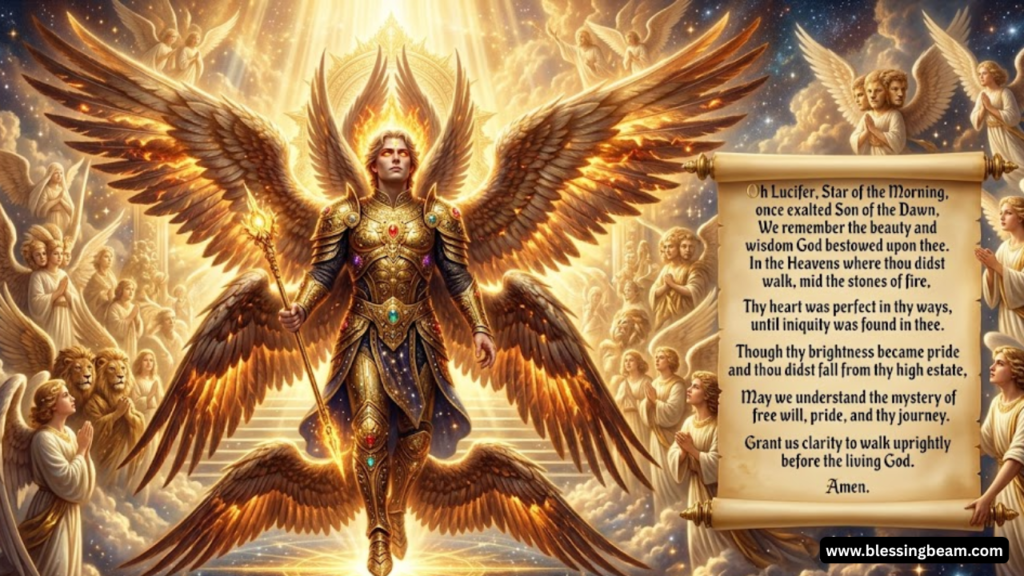
Lucifer Angel
Ezekiel presents him as “the seal of perfection,” an anointed guardian cherub adorned with nine precious stones, walking among fiery stones on God’s holy mountain. His designation as “anointed guardian cherub” placed him at the highest rank among cherubim, those beings who guard God’s holiness and serve in His immediate presence.
Scripture records: “Thou art the anointed cherub that covereth; and I have set thee so: thou wast upon the holy mountain of God; thou hast walked up and down in the midst of the stones of fire. Thou wast perfect in thy ways from the day that thou wast created, till iniquity was found in thee.” As an angel, Lucifer was the highest expression of created beauty and wisdom which is exactly what makes his fall the most sobering event in all of spirituality.
Frequently Asked Questions
Is “Lucifer” actually a name for Satan in the Bible?
No, it is not. The word “Lucifer” appears only once in the entire Bible (Isaiah 14:12) and was originally a Latin word meaning “morning star” or “light-bearer.” It referred to the King of Babylon, not a supernatural being named Satan.
Where did the idea of Lucifer as a fallen angel come from?
It came mostly from later Christian interpretation, not directly from scripture. Early church fathers like Origen and Tertullian connected Isaiah 14 to Luke 10:18 (“I saw Satan fall like lightning”), and that theological reading gradually became a popular church tradition.
What does Isaiah 14:12 actually say in its original context?
It is a taunt poem mocking the arrogant King of Babylon. The “morning star” imagery describes a proud ruler who tried to elevate himself above all others and was brought low. It was never written as a biography of a spiritual being.
Did Jesus ever call Satan “Lucifer” in the Bible?
No, he did not. Jesus referred to the adversary as “Satan,” “the devil,” “the evil one,” and “the father of lies” never once as Lucifer. That name simply does not appear in the New Testament at all.
How did the name “Lucifer” end up in English Bibles?
It came through the Latin Vulgate Bible, translated by Jerome around 400 AD. Jerome used “lucifer” as a translation for the Hebrew word “helel,” meaning “shining one.” Later English translators carried the word over, and readers eventually treated it as a proper name.
Is Satan described anywhere in the Bible as a beautiful, high-ranking angel?
Some passages like Ezekiel 28 and Isaiah 14 are interpreted that way, but scholars debate whether these texts describe a heavenly being at all. Ezekiel 28 was also written as a lament over the King of Tyre, a human ruler, not a fallen angel.
So where does the popular image of Lucifer come from?
Mostly from literature and art, not the Bible itself. Works like Dante’s Inferno and Milton’s Paradise Lost shaped the dramatic image of a beautiful, rebellious angel cast from heaven. These are powerful stories, but they are creative works not scriptural accounts.
Conclusion
The word “Lucifer” was never meant to be Satan’s name. It was a Latin title describing a Babylonian king, not a cosmic villain. Centuries of tradition, literature, and art turned a metaphor into a myth.
Understanding the Bible in its original context changes everything. The real text is far more grounded and historical than most people realize. Letting go of Hollywood’s version brings you closer to what scripture actually says.

Welcome to Blessings Beam. I’m David, an Unique SEO and Content Writer with 5 years of experience. I help websites rank higher, increase organic traffic, and deliver impactful content that genuinely connects with readers. My goal is to make SEO simple, effective, and results-driven. Let’s achieve more together.