
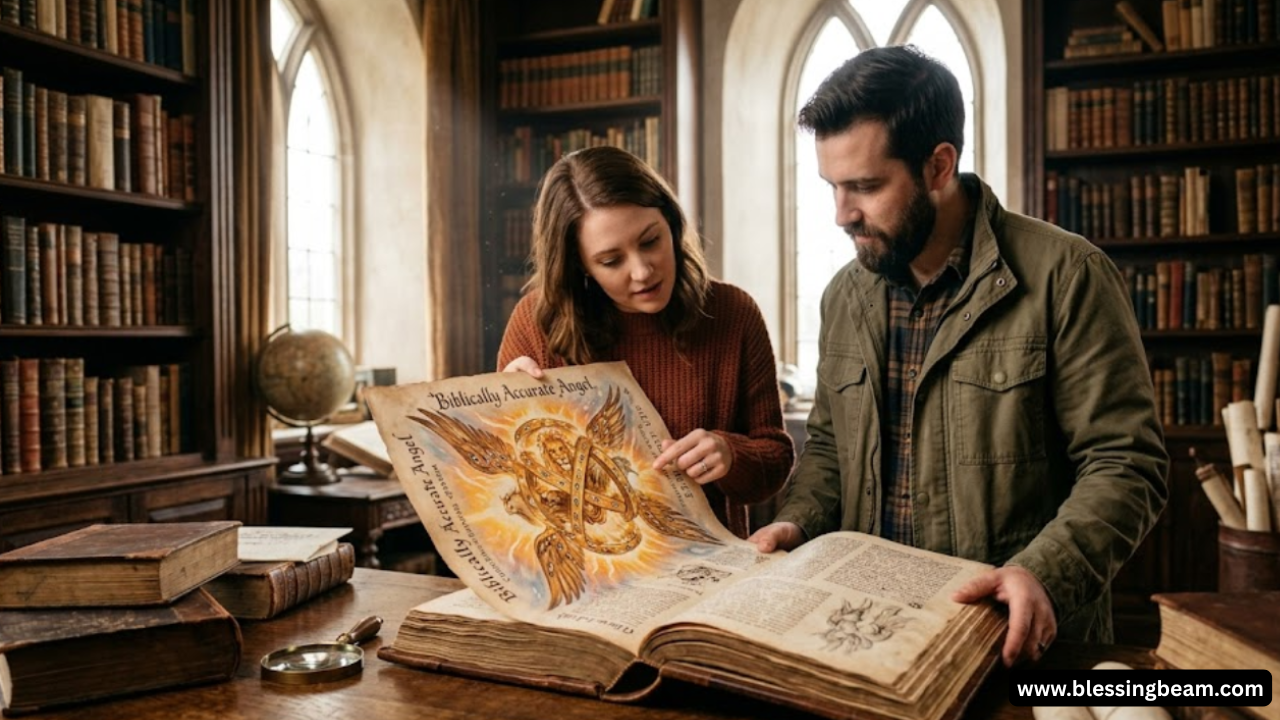
Angels in the Bible look nothing like the gentle, winged figures we see in paintings and movies. Scripture describes them as powerful, awe-inspiring beings that cause even the bravest people to fall to the ground in fear. Understanding what the Bible actually says about angels changes everything we think we know.
The Bible describes many kinds of angels, each with a unique role and appearance. Some have multiple wings and faces, others look like wheels covered in eyes, and a few appear as ordinary humans. These beings were created by God to carry out His will, deliver messages, and worship Him day and night.
Knowing the true nature of angels helps us see how great and mighty God really is. If the creatures He made are this powerful and glorious, how much greater must He be? Studying biblical angels is not just interesting, it points us back to the majesty and holiness of God Himself.
The Biblical Foundation of Angels
What Scripture Reveals About Angels
The Bible does not introduce angels with a formal definition or a systematic theological explanation. Instead, angels appear throughout Scripture as assumed realities beings whose existence is never argued for but simply declared. From Genesis to Revelation, the presence of angels weaves through the biblical narrative as naturally as the presence of kings, prophets, and ordinary men and women. The Scriptures treat angelic beings not as mythological constructs borrowed from surrounding cultures, but as genuine members of a created, spiritual order that operates within and alongside the physical world.
The Old Testament contains hundreds of references to angelic beings, appearing in the Hebrew under various titles and descriptions. The New Testament confirms and expands upon these revelations, with Jesus Himself affirming the reality of angels on multiple occasions. The Apostle Paul, writing to the early churches, treats angelic beings as settled theological facts, using them as reference points for arguments about conduct, authority, and cosmic order. The writer of Hebrews devotes an entire opening section to distinguishing Christ from angels which only makes sense if the original readers held angels in high regard as genuine spiritual beings.
What Scripture reveals about angels is not a complete or exhaustive portrait. The Bible is not an angelology textbook. Rather, angels are revealed insofar as they relate to God’s redemptive purposes and human history. We learn about them through their appearances, their assignments, their worship, and their actions. We discover their nature not through philosophical speculation but through eyewitness accounts preserved in inspired text Isaiah’s vision in the temple, Ezekiel’s encounter by the river Chebar, John’s extraordinary revelations on the island of Patmos, and the simpler but equally significant appearances recorded throughout the Gospels and Acts.
Angels are described as innumerable. The writer of Hebrews speaks of “an innumerable company of angels” (Hebrews 12:22), and Daniel records that “ten thousand times ten thousand stood before him” (Daniel 7:10). Jesus, in the Garden of Gethsemane, reminded Peter that He could call upon twelve legions of angels if needed (Matthew 26:53) a Roman legion consisting of approximately six thousand soldiers, meaning Christ referenced a possible angelic mobilization of over seventy thousand beings for His personal defense alone. These are not incidental numbers. They signal a vast, ordered, and populated spiritual realm that runs parallel to and intersects with the material world.
Scripture also reveals that angels are created beings. This is a theologically essential point. They are not eternal in the way God is eternal. They are not self-existent, self-sustaining, or divine by nature. Colossians 1:16 declares that all things were created through Christ and for Him — “whether thrones or dominions or rulers or authorities” and this includes the angelic host. They were created before the physical universe, as implied by Job 38:7, where God asks Job where he was “when the morning stars sang together and all the sons of God shouted for joy” at the founding of the earth. Angels predated humanity, witnessed creation, and have observed human history from its very beginning.
They are also revealed as morally responsible beings. Angels can sin, as demonstrated by the fall of Satan and other rebellious angels. They exercise will, make choices, and operate with genuine agency. This distinguishes them from impersonal forces or mere divine instruments without inner life. The fallen angels chose rebellion. The holy angels, by contrast, are confirmed in their holiness referred to as “elect angels” in 1 Timothy 5:21 suggesting a divine act of confirmation that secured their standing before God.
The Etymology and Meaning of ‘Angel’
The English word “angel” derives from the Latin angelus, which is itself a transliteration of the Greek word angelos (ἄγγελος). The Greek term carries the primary meaning of “messenger” — one who is sent, one who bears a communication from another. This is the functional definition of an angel as most commonly encountered in Scripture. The Greek word was also used in secular Greek literature to describe human messengers and envoys, which is why the context of any given biblical passage must determine whether the angelos in question is a human or a heavenly being.
In the Hebrew Old Testament, the equivalent word is mal’ak (מַלְאָךְ), which similarly means “messenger” or “one who is sent.” This Hebrew word is used interchangeably for human messengers and for divine agents. For example, in Malachi 2:7, priests are called mal’ak, messengers of the Lord of hosts. In Malachi 3:1, the coming prophet is called a mal’ak who will prepare the way. Yet throughout Genesis, Exodus, and the Prophets, the same word describes heavenly beings dispatched from God’s presence to interact with humanity.
This etymological overlap is significant for a number of reasons. First, it reminds us that the defining characteristic of an angel, as Scripture presents it, is not primarily its nature but its function. Angels are fundamentally messengers beings sent by God for specific purposes. Their identity is tied to their mission. They exist in relation to the One who sends them and in service to those to whom they are sent. Second, the overlap between human and heavenly messengers in biblical terminology explains why some scholars debate certain passages about the “Angel of the Lord” a figure who in some texts appears to be a distinct divine being, possibly a pre-incarnate appearance of Christ, speaking with the full authority of God Himself.
The word angel therefore carries no inherent description of appearance, rank, power, or hierarchy. It is simply “messenger.” All the rich diversity of angelic beings described in Scripture seraphim, cherubim, archangels, living creatures, the host of heaven falls under the broader category of God’s heavenly servants, but the specific term “angel” focuses on their communicative and mediatorial role. When we read that an angel appeared to Mary, or to Zechariah, or to the shepherds of Bethlehem, the emphasis is on the divine message being delivered through a sentient being, not merely on the spectacular nature of the encounter.
Understanding this etymological foundation helps correct popular misunderstandings. The popular imagination has loaded the word “angel” with connotations drawn from Renaissance art, Victorian sentimentality, and modern entertainment. But stripped back to its biblical root, an angel is a messenger, a being of immense spiritual dignity and power, dispatched from the throne of God, bearing the word and will of the Almighty to wherever He chooses to send them.
Angels as Spiritual Beings and Ministering Spirits
Hebrews 1:14 provides what may be the clearest single-sentence theological definition of angels found anywhere in Scripture: “Are they not all ministering spirits sent out to serve for the sake of those who are to inherit salvation?” This verse is rich with meaning and deserves careful unpacking. It identifies angels as spirits, as ministers, and as sent servants dispatched for the benefit of redeemed humanity.
That angels are spirits means they are non-physical beings in their essential nature. They do not have bodies of flesh and bone as humans do. They are not composed of the material elements of the created world. This distinguishes them fundamentally from human beings, who are embodied souls or in biblical anthropology, animated bodies given life by the breath of God. Angels belong to the realm of spirit, which is why they can operate in ways impossible for material beings: appearing and disappearing, traversing vast distances instantaneously, and functioning in both the visible and invisible dimensions of reality.
However, Scripture also records angels appearing in physical form sometimes in forms indistinguishable from ordinary human beings. The writer of Hebrews warns believers to show hospitality to strangers, noting that “some have entertained angels unawares” (Hebrews 13:2), a clear reference to the account in Genesis 18 where Abraham hosted three visitors who turned out to be divine messengers. The two angels who visited Lot in Sodom were perceived as men by the inhabitants of the city (Genesis 19:1-5). This capacity for angelic beings to take on visible, apparently physical form does not contradict their spiritual nature. It indicates rather that angels can clothe themselves in physical appearance as an act of condescension to human perception and accommodation to the limitations of human sight.
As ministering spirits, angels are servants. The word used in Hebrews 1:14 for “ministering” is leitourgika, a word related to leitourgia, from which we derive the English word “liturgy.” It carries connotations of sacred service, priestly ministry, and appointed duty. Angels are not independent operators pursuing their own agendas. They are servants of the Most High, carrying out assignments within a divine order that reflects the majesty and governance of God. Their ministry is purposeful, directed, and ordered by heavenly authority.
The phrase “sent out to serve for the sake of those who are to inherit salvation” is remarkable. It grounds angelic ministry in human redemption. Angels serve in connection with the salvation of human beings, a reality that 1 Peter 1:12 confirms, noting that the angels long to look into the things proclaimed in the gospel. Angels are not the primary agents of salvation — that belongs to Christ alone but they serve within the framework of redemption, ministering to those who are being saved, carrying out divine assignments on behalf of God’s redeemed people. This gives angelic ministry a distinctly Christocentric and soteriological character that popular culture almost entirely misses.

Contrasting Biblical Angels with Popular Culture
How Modern Media Misrepresents Angels
The gap between the biblical portrait of angels and the portrait presented by modern media is so vast as to constitute a nearly complete reversal. Popular culture has systematically softened, domesticated, and reimagined angelic beings in ways that strip them of their biblical characteristics and replace them with images drawn from Romantic-era art, New Age spirituality, sentimental religion, and entertainment industry conventions. Understanding these distortions is important not merely for intellectual accuracy but because false ideas about angels can lead to false ideas about God, about spiritual reality, and about the nature of divine help and protection.
The most pervasive misrepresentation is the depiction of angels as gentle, winged humans with soft features, white robes, and an air of comforting warmth. This image owes far more to medieval and Renaissance European art than to any biblical text. Renaissance painters working within Christian cultural frameworks but importing heavily from classical aesthetic conventions depicted angels as beautiful human figures with bird-like wings, often arranged in celestial groupings that conveyed beauty and order. These images were not intended as literal theological statements but as artistic interpretations. Over centuries, however, the artistic convention became the popular assumption, and millions of people today believe that this is what the Bible describes.
In reality, the biblical descriptions of angels are frequently so startling that they defy comfortable domestication. When Ezekiel encounters the living creatures by the Chebar River, the description he provides reads more like a science fiction account than a greeting-card scene. When Isaiah saw the seraphim in the temple, the experience was so overwhelming that his first response was a cry of personal unworthiness and despair. When angels appear throughout the New Testament, the consistent human response is fear not comfort, not warmth, but terror. This consistent pattern of human fear in angelic encounters is one of the strongest arguments against the popular cultural image, and it is rooted in the very nature of what holy, powerful, spiritual beings actually are.
Modern entertainment has also popularized the idea of angels as deceased humans who have been promoted to angelic status earning their wings through good deeds or completing heavenly assignments. This idea, while emotionally appealing, has no biblical support whatsoever. Angels and humans are categorically distinct orders of created being. Humans do not become angels at death. The redeemed dead become glorified human beings, not angels. Scripture presents the resurrection as the restoration and glorification of human nature, not its transformation into a different species of being. Hebrews 2 actually indicates that redeemed humanity will in some sense surpass the angels in the eschaton, as human beings made in the image of God are brought into fuller union with Christ the God-Man who is now seated above all angelic powers.
The New Age movement has contributed its own layer of misrepresentation by presenting angels as semi-divine, universally available spirit guides who serve all human beings regardless of faith commitment, moral standing, or relationship to God. In this framework, anyone can contact and communicate with angels through meditation, prayer, or spiritual practice, and angels function essentially as benevolent cosmic helpers tuned in to human desires and wellbeing. This fundamentally inverts the biblical relationship. In Scripture, angels serve God not humanity directly, and not as responders to human spiritual initiatives. They are dispatched by God for purposes determined by God. The idea that humans can summon, direct, or establish ongoing communication with specific angels has no biblical basis and directly resembles the kinds of practices explicitly condemned in the Old Testament as consultation with spirits.
Why Angels Say ‘Fear Not’ in Scripture
One of the most telling details in biblical angelic encounters is the frequency with which angels preface their message with the command “Fear not” or its equivalent “Do not be afraid.” This phrase appears so regularly in angelic encounters that it functions almost as a standard opening greeting. Gabriel says it to Zechariah (Luke 1:13), to Mary (Luke 1:30), and to Daniel (Daniel 10:12). The angel who appears to Joseph says it (Matthew 1:20). The angel at the tomb says it to the women (Matthew 28:5). The risen Christ says it to John on Patmos (Revelation 1:17). The regularity of this command reveals something critically important: the natural human response to a real angelic encounter is fear.
This is not the mild discomfort of encountering something unfamiliar. The biblical language describes profound terror Daniel was so overwhelmed by the presence of the angelic being in Daniel 10 that all his strength left him, he fell to the ground as though dead, and remained trembling. The shepherds of Bethlehem were described as “sore afraid” , a Greek phrase indicating extreme, gripping terror at the appearance of a single angel. The guards at the tomb became “like dead men” at the angel’s appearance. These are not comfortable, reassuring encounters in the popular sense. They are confrontations with a category of being so far above ordinary human experience that the human nervous system and psychological constitution struggle to bear the encounter.
The “Fear not” command is therefore not evidence that angels are gentle and unthreatening. It is evidence of exactly the opposite. The command is necessary precisely because the angelic presence is terrifying. The angel must actively reassure the human that this terrifying encounter does not signal destruction or divine wrath before the human can receive any further communication. The reassurance follows the terror as a deliberate pastoral intervention. Understanding this sequence of terror, command to peace, divine message reveals the true character of biblical angelic communication: authoritative, overwhelming, and requiring divine grace for the human recipient to even survive the encounter in a functional state.
This also serves as a strong critique of any spirituality that claims peaceful, comfortable, serene experiences with angelic beings as validation of those encounters. The biblical pattern runs exactly contrary. If an encounter with a supposed angelic being produces primarily comfort, warmth, and spiritual affirmation without any trace of the overwhelming awe and terror that attends genuine biblical encounters, the biblical precedent at least raises questions about the nature of the entity in question.

Archangels: The Named Messengers of Heaven
Michael: The Warrior Prince
Michael is one of only two angels explicitly named in the canonical Scriptures of both Old and New Testaments, and his character is consistently and unmistakably martial. His very name is a declaration of theological truth: Mikha’el in Hebrew means “Who is like God?” a rhetorical question that functions as a declaration of divine incomparability. The name itself is a battle cry, asserting that no power, no being, no force in the heavens or on the earth can stand in comparison to the Almighty.
Michael appears in Daniel 10 and 12, in Jude 9, and in Revelation 12. Each appearance reinforces his identity as a warrior, a protector, and a defender of God’s people. In Daniel 10, the prophet receives a vision but is visited first by a powerful angelic figure likely distinct from Michael who explains that he was delayed for twenty-one days because the “prince of Persia” withstood him, and that Michael, “one of the chief princes,” came to assist him. This passage is remarkable for several reasons. It describes a genuine spiritual warfare in which angelic beings are engaged in conflict with demonic powers that hold sway over earthly nations. Michael is identified as one of the chief princes suggesting a hierarchy of angelic authority and as Israel’s defender in particular.
Daniel 12:1 explicitly assigns Michael a national role: “At that time shall arise Michael, the great prince who has charge of your people.” This assigns to Michael a specific and sustained responsibility for the welfare of Israel a guardianship that extends through the tribulation period described in Daniel’s apocalyptic vision. Michael is not merely a warrior by temperament or assignment; he is a prince, a figure of governmental and spiritual authority who holds a position of leadership within the angelic hierarchy.
In Jude 9, Michael appears in a brief but illuminating episode that demonstrates both his power and his propriety. When disputing with the devil over the body of Moses a reference to an event not recorded elsewhere in canonical Scripture but apparently known to Jude’s readers Michael “did not presume to pronounce a blasphemous judgment” against Satan but instead said, “The Lord rebuke you.” This is instructive. Michael, even as the great warrior prince, does not act in his own authority or out of personal contempt. He invokes divine authority rather than exercising his own. This models a crucial spiritual principle: even the greatest of God’s warriors operates under divine authority, not independently of it.
Revelation 12 presents Michael in his most dramatic role as the general of heaven’s armies in the great eschatological war. “Now war arose in heaven, Michael and his angels fighting against the dragon. And the dragon and his angels fought back, but he was defeated, and there was no longer any place for them in heaven.” This passage depicts an actual military engagement in the spiritual realm, with Michael leading the angelic host against Satan and his fallen angels. The outcome is decisive: Satan and his forces are cast out of heaven and the passage is followed by a hymn of cosmic celebration.
Gabriel: God’s Chief Herald
If Michael is the warrior, Gabriel is the herald, the chief communicator of divine messages, particularly those relating to God’s redemptive purposes and prophetic timeline. Gabriel’s name in Hebrew, Gavri’el, means “Man of God” or “God is my strong one” a name that reflects both his closeness to God and the divine strength behind his mission. He appears in Daniel 8 and 9, and in Luke 1, and in each appearance he carries messages of extraordinary prophetic and redemptive significance.
Gabriel’s first recorded appearance is in Daniel 8, where he is sent to explain to Daniel the vision of the ram and the goat, a vision with far-reaching prophetic implications concerning Persia, Greece, and the desecration of the temple. Gabriel approaches Daniel and speaks to him with authority and urgency, explaining that the vision concerns “the time of the end.” In Daniel 9, Gabriel returns to Daniel while he is in prayer, and the timing is striking. Gabriel arrives at the moment of Daniel’s intercession and delivers the famous prophecy of the seventy weeks, one of the most detailed and precise prophetic passages in the entire Old Testament.
In Luke 1, Gabriel appears twice in rapid succession first to Zechariah in the Jerusalem temple to announce the coming birth of John the Baptist, and then to Mary in Nazareth to announce the incarnation of the Son of God. Gabriel’s announcement to Mary “Hail, favored one! The Lord is with you!” is arguably the most consequential single communication in the history of the world, as it inaugurates the earthly life of the Son of God. Gabriel identifies himself by name to Zechariah, saying, “I am Gabriel, who stands in the presence of God, and I was sent to speak to you.” The phrase “who stands in the presence of God” indicates a position of immediate divine access Gabriel is not an angel from the outer courts of heaven but one who stands before the throne itself, dispatched directly from the presence of the Almighty.
Gabriel’s consistent role across all his appearances is the communication of redemptive and prophetic truth. He is sent specifically to people who are praying, who are seeking God, or who are chosen for unique roles in salvation history. He brings clarity to confused visions, announces supernatural births, and inaugurates redemptive epochs. He does not appear as a warrior or an executor of judgment. His mission is the proclamation of God’s saving purposes at pivotal moments in human history.
The Unique Role of Named Angels
The fact that only Michael and Gabriel are named in canonical Scripture is itself theologically significant. The Book of Tobit, considered deuterocanonical by Catholic and Orthodox traditions, names Raphael as a third angel, and the apocryphal literature multiplies angelic names considerably. But within the Protestant and Jewish canonical Scriptures, the naming of only two angels reflects a principle of divine selectivity: not every angel is named because angelic names are not given for the sake of human knowledge or spiritual connection, but for specific revelatory purposes.
The naming of Michael and Gabriel serves to personalize and distinguish beings who carry out repeated, sustained, and uniquely important assignments in redemptive history. Michael’s name reminds us that the warfare of heaven is conducted under the banner of divine incomparability. Gabriel’s name and identity attach the most important prophetic and redemptive announcements in history to a specific, identified messenger creating continuity between Daniel’s prophetic ministry and the birth of Christ, and anchoring both in the same heavenly envoy.
The rarity of named angels in Scripture also cautions against the popular practice of naming and invoking specific angels in prayer or spiritual practice. When people today pray to or through named angels Uriel, Saraqael, Remiel, and the many others found in pseudepigraphical literature they go beyond what Scripture sanctions and enter territory that the Bible itself does not illuminate. The revealed names serve revealed purposes. Beyond those purposes, divine wisdom has withheld the names, and wisdom follows that same restraint.

Seraphim: The Fiery Worshipers at God’s Throne
The Six Wings and Their Symbolic Meaning
The seraphim appear in only one passage of canonical Scripture Isaiah 6:1-7 but their appearance in that passage is so vivid and theologically concentrated that it has shaped Christian and Jewish reflection on heavenly worship for millennia. Isaiah’s vision occurs “in the year that King Uzziah died” a moment of political instability and national uncertainty and it begins with a breathtaking scene: the Lord seated on a high and exalted throne, His robe filling the temple, and above Him the seraphim in attendance.
The word seraph (שָׂרָף) in Hebrew means “burning one” or “fiery being.” The root saraph is used elsewhere in Scripture to describe burning the burning serpents of Numbers 21, and fire more generally. The seraphim are therefore beings associated with fire, radiance, and consuming holiness. They are creatures of holy fire, attending the holy God, and their very name communicates something of the consuming, purifying nature of divine holiness in whose immediate presence they dwell.
Each seraph in Isaiah’s vision has six wings. The description of the wings’ use is carefully detailed and profoundly meaningful. Two wings cover the seraph’s face, an act of reverence before the overwhelming glory of God. Even these exalted, holy, burning beings veil themselves in the presence of the divine holiness. They cannot look directly at God without covering their eyes. This shatters any idea that familiarity with God diminishes awe. The beings closest to God those who stand in His immediate presence are the most acutely aware of His transcendent holiness. Two wings cover the seraph’s feet an act of humility, possibly indicating an awareness of their own creature-status before the Creator, covering what might be considered the lowest and most earthly part of their form. And two wings are used for flight the wings of active mission, ready for service.
The threefold distribution of the wings speaks symbolically to the three fundamental postures of the holy life: reverence before God (covering the face), humility in God’s presence (covering the feet), and readiness for service (wings for flight). The seraphim embody in their very physical form or whatever form they possess the perfect integration of worship, humility, and active obedience. They are the celestial model of what it looks like to be fully oriented toward God.
The Threefold Holy Proclamation
The seraphim in Isaiah 6 do not stand in silent attendance. They cry out to one another in a liturgical antiphon, a call-and-response act of worship that reverberates through the heavenly temple. Their proclamation is: “Holy, holy, holy is the LORD of hosts; the whole earth is full of his glory.” This threefold repetition of the word “holy” is known as the Trisagion the thrice-holy and it occupies a position of supreme importance in both Jewish and Christian liturgical traditions.
The triple repetition of “holy” is not rhetorical excess or Hebrew poetic convention for the sake of rhythm. Hebrew poetry uses repetition to convey intensification: doubling a word strengthens it, tripling it maximizes it. The threefold “holy” is the most emphatic possible declaration of divine holiness in the Hebrew linguistic framework. It means that God’s holiness is not merely great, not merely surpassing, but absolutely maximized, complete, perfect, infinite. There is no higher category. Nothing can exceed the holiness declared by the seraphim in this moment.
The proclamation continues: “the whole earth is full of his glory.” This is striking precisely because Isaiah receives this vision at a moment of national crisis. Israel’s future is uncertain. The political landscape is shifting. Yet the seraphim declare that the whole earth, not just the temple, not just Israel, not just the visible heavens, is full of the glory of the Lord. This is a declaration of God’s sovereign, pervasive, and unchallengeable presence throughout all creation, regardless of the contingencies of human history.
The effect of this proclamation on the physical environment is dramatic. “The foundations of the thresholds shook at the voice of him who called out, and the house was filled with smoke.” The seraphic worship is so potent that it produces physical reverberations, the doorposts of the heavenly temple shaking, the space filled with smoke. This worship is not quiet or gentle. It is powerful, overwhelming, and creation-shaking. It is the kind of worship that God’s holiness actually demands and produces.
Seraphim’s Role in Purification
The seraphim’s role in Isaiah 6 extends beyond worship to active participation in the prophet’s purification. When Isaiah responds to the divine vision with the cry “Woe is me! For I am lost; for I am a man of unclean lips, and I dwell in the midst of a people of unclean lips; for my eyes have seen the King, the LORD of hosts!” one of the seraphim takes action. He flies to the altar, takes a burning coal with tongs, and touches it to Isaiah’s lips, declaring, “Behold, this has touched your lips; your guilt is taken away, and your sin atoned for.”
This act situates the seraphim within the broader economy of divine grace, not merely as worshipers but as agents of purification and preparation. The burning coal taken from the altar, the place of sacrifice and atonement is applied to the place of Isaiah’s confessed uncleanness: his lips. The purification is specific, targeted, and effective. It addresses the exact point of the prophet’s failure and unworthiness, and it prepares him for the prophetic mission to follow. Immediately after this cleansing, God asks, “Whom shall I send?” and Isaiah can respond, “Here I am! Send me” a response that would have been impossible before the purification.
The seraphim thus function as mediating agents of divine holiness beings who stand in God’s presence and who carry the fire of that presence to human beings for their cleansing and commissioning. This is consistent with the broader angelic function of service to those who will inherit salvation, but it gives the seraphim a distinctive purifying and preparatory role that fits their fiery, holy nature perfectly.

Cherubim: The Multi-Faced Guardians of Holy Places
Cherubim Guarding the Garden of Eden
The cherubim make their first appearance in Scripture immediately after the expulsion of Adam and Eve from the Garden of Eden in Genesis 3:24. God drives the first human couple from Eden and places cherubim at the east entrance of the garden, along with a flaming sword that turned every direction, to guard the way to the Tree of Life. This is the first angelic assignment explicitly recorded in Scripture, and its nature is instantly revealing: cherubim are guardians of sacred, holy space. They are set as sentinels at the boundary between the holy and the ordinary, between the divine presence and fallen humanity.
The placement of cherubim at Eden establishes a pattern that runs throughout subsequent revelation. Wherever the holiness of God is concentrated wherever divine presence intersects most intensely with created space cherubim are found as guardians and attendants. They do not merely decorate holy space. They actively protect it from inappropriate access. The flaming, turning sword they wield communicates an inescapable and dynamic defense; there is no angle of approach, no moment of inattention, through which fallen humanity might re-enter the sacred garden and access the Tree of Life without divine permission.
This guardianship function carries an important theological message. The cherubim at Eden’s gate are not merely a physical obstacle. They are a visual and theological statement about the seriousness of sin’s consequences and the inaccessibility of divine life to unregenerate humanity. The way back to life back to the Tree that represents immortal communion with God is barred. It requires divine action, not human ingenuity or effort, to reopen access. This sets the stage for the entire redemptive narrative: God Himself must provide the way back to the Tree of Life, which He ultimately does through Christ, who opens access to the restored Eden of the new creation (Revelation 22:2).
The Four Faces and Their Significance
Ezekiel’s vision of the cherubim in chapters 1 and 10 provides the most detailed physical description of these beings found anywhere in Scripture. Each cherub has four faces: the face of a man (or human being), the face of a lion, the face of an ox (or cherub, as Ezekiel 10 also identifies), and the face of an eagle. Each cherub also has four wings different from the seraphim’s six and their form is described as human in general outline but gloriously and terrifyingly complex.
The four faces of the cherubim have generated extensive theological reflection. The most influential interpretation in the early church associated the four faces with the four Gospels: Matthew (the man, emphasizing Jesus’ humanity), Mark (the lion, emphasizing Christ’s royal authority and power), Luke (the ox, emphasizing Christ’s priestly sacrifice), and John (the eagle, emphasizing Christ’s divine transcendence and heavenly origin). This fourfold symbolism was popularized by Irenaeus and became standard in Christian iconography, which is why the four evangelists’ symbols are lions, oxen, eagles, and human figures throughout Christian art and architecture.
Beyond the evangelical interpretation, the four faces may symbolize the fullness of animate creation. Humanity (man) stands at the pinnacle of terrestrial creation the image-bearers of God. The lion is the king of wild beasts. The ox is the chief of domestic animals. The eagle is the supreme creature of the air. Together, the four faces suggest that the cherubim embody or represent the totality of creaturely existence that they are, in some sense, the representative creatures of all creation, standing before God on behalf of everything that has been made. Their guardianship of holy space is therefore not just the protection of a divine locale but the orientation of all creation toward its Creator.
Cherubim on the Ark of the Covenant
The cherubim appear in the design and furnishings of Israel’s sacred spaces in ways that reinforce their role as guardians and attendants of divine presence. God commands Moses to construct the Ark of the Covenant with two golden cherubim facing each other on the mercy seat the lid of the ark with their wings spread over it and their faces turned downward toward the mercy seat (Exodus 25:18-22). The ark was the earthly locus of God’s presence among Israel, the place where He said He would meet with Moses and speak from “between the two cherubim” an arrangement that deliberately mirrors the heavenly reality, where God’s throne is attended by the actual cherubim.
This architectural theology communicates that the earthly tabernacle and temple are designed as reflections of heavenly realities. The golden cherubim on the ark are not decorative elements. They are theological statements — icons of the heavenly guardians who attend God’s actual throne, locating the earthly ark within the same sacred geography as the heavenly dwelling of God. When Solomon built the temple, he added colossal carved cherubim in the Holy of Holies fifteen feet tall, with wingspans of fifteen feet each, arranged so that their inner wings touched in the center of the room over the ark, and their outer wings touched the walls (1 Kings 6:23-28). The entire Holy of Holies was visually dominated by these guardians of holy presence.
Cherubim imagery was also woven into the curtains of the tabernacle (Exodus 26:1) and carved into the walls and doors of Solomon’s temple (1 Kings 6:29-35), making the entire sacred structure a continuous visual declaration of divine presence attended by heavenly guardians. The worshiper who entered the tabernacle or temple was immediately surrounded by the cherubim, reminded at every point that they were approaching a space of divine holiness, attended by beings of vast spiritual power.
Eyes Symbolizing God’s Omniscience
Ezekiel’s cherubim are described as covered with eyes not just having eyes in their faces but covered with eyes throughout their bodies, including on their wings (Ezekiel 1:18, 10:12). This same feature reappears in the four living creatures of Revelation 4, who are “full of eyes in front and behind” and whose wings are “full of eyes all around and within.” This extraordinary feature is consistently interpreted as a symbol of divine omniscience all-seeing perception that misses nothing, that is aware of everything, in all directions, at all times.
The cherubim and living creatures who attend God’s throne are, in their very bodies, declarations of the character of the God they serve. Their covering of eyes proclaims that nothing is hidden from God. Every event in all creation, every thought in every heart, every moment in all of time and space all is seen, all is known, all is perceived by the One before whose throne these all-seeing creatures stand. The eyes do not suggest that the creatures themselves are omniscient that attribute belongs to God alone but that they serve as creaturely manifestations or representations of God’s all-seeing character, living emblems of divine omniscience placed at the very center of heavenly reality.

Living Creatures and Ophanim: The Most Mysterious Angels
Ezekiel’s Vision of the Living Creatures
Ezekiel’s opening chapter is one of the most astonishing passages in all of Scripture. The prophet, among the Jewish exiles by the Chebar River in Babylon, sees “a stormy wind” coming from the north a great cloud with fire flashing back and forth, with brightness around it, and from its center something like gleaming metal. From within this fire emerge four living creatures (chayyot in Hebrew), and the description that follows is unlike anything else in biblical literature.
Each living creature has the general form of a human being but has four faces, four wings, and legs that are straight, with feet like the soles of a calf’s foot, gleaming like burnished bronze. Their wings are joined to one another, and they do not turn as they move they go straight forward, in whatever direction the Spirit wills, without turning. From between the living creatures come burning coals of fire, and torches moving back and forth among them, and lightning flashing out. They move with the speed of lightning.
Beside each living creature is a wheel on the earth and here the vision compounds its mystery. The wheels are described as gleaming like beryl, and each wheel has another wheel intersecting it at right angles. The rims of the wheels are high and awesome, and all four rims are full of eyes all around. The wheels do not turn independently; they go wherever the living creatures go, moving in any direction without needing to turn, because “the spirit of the living creatures was in the wheels.” Above the living creatures is an expanse, like the gleaming of crystal, awesome and terrifying. Above the expanse is a likeness of a throne, and on the throne is a likeness with the appearance of a human form the glory of the Lord.
The Wheel Angels: Ophanim Explained
The wheels in Ezekiel’s vision in Hebrew ophanim (אוֹפַנִּים), meaning “wheels” or “wheeled ones” have been treated in Jewish mystical tradition as a distinct order of angelic beings. The tradition of Jewish apocalyptic literature, including texts like 1 Enoch and 3 Enoch, elaborates extensively on the ophanim, placing them in a hierarchical scheme alongside the seraphim, cherubim, and other angelic orders. While these post-biblical texts are not authoritative Scripture, they reflect sustained Jewish reflection on Ezekiel’s vision and indicate that the wheel beings were understood as genuinely distinct spiritual entities rather than mere mechanical conveyances.
In the canonical text, the wheels are animated by “the spirit of the living creatures” they are not mere vehicles but living participants in the divine chariot (Merkavah in Hebrew the chariot-throne of God). They move in perfect coordination with the living creatures, going wherever the creatures go, rising when they rise, stopping when they stop. This perfect coordination reflects the perfect unity of will and direction that characterizes beings operating under divine authority and divine Spirit. They do not function independently. They function as an integrated whole under divine direction.
The Merkavah mysticism that developed in Jewish tradition around Ezekiel’s vision is an indication of how profoundly this chapter captured the religious imagination. The chariot-throne, the moving, living, all-seeing, Spirit-filled vehicle of divine presence became the central image of Jewish mystical contemplation for centuries. While the mystical elaborations themselves go far beyond the biblical text, they testify to the power and theological richness of Ezekiel’s vision and the genuine mystery of the ophanim.
Wheels Within Wheels Covered With Eyes
The specific detail of “a wheel within a wheel” or wheels intersecting each other has generated considerable theological and philosophical reflection. The most straightforward interpretation is that the intersecting wheels allow movement in any direction without turning. A single wheel can only roll in one direction along its axis. But two wheels set at right angles to each other — one horizontal and one vertical, or one set in each cardinal direction can effectively roll in any direction. This explains the living creatures’ ability to move without turning: the ophanim function as an omni-directional conveyance that can carry the divine chariot-throne anywhere in creation instantly.
The eyes covering the rims of the wheels reinforce the same symbolism found on the cherubim and the four living creatures themselves: omniscience, all-seeing perception, the all-encompassing awareness of God whose chariot this is. The wheels are not blind, mechanical things. They are alive with eyes, aware in all directions, seeing everything as they move through creation carrying the divine presence. The whole vision presents a God who is not stationary, not limited to a fixed location, but omnipresent and mobile whose throne moves freely through all creation, attended by all-seeing, all-directed beings whose movement is governed entirely by the divine Spirit.
Also Read This: 360+ Uplifting Prayers for the New Month of April with Bible Verses for Blessings, Guidance, and New Beginnings
The Relationship Between Living Creatures and Cherubim
Ezekiel 10 makes an explicit identification that resolves a question that chapter 1 leaves open. When Ezekiel sees the living creatures again in chapter 10, he states clearly: “And I knew that they were cherubim.” The living creatures of chapter 1 those four-faced, four-winged, wheel-attended beings of extraordinary mystery are the same beings identified elsewhere as cherubim. This connection integrates Ezekiel’s mysterious vision with the broader biblical portrayal of cherubim as guardians of divine presence, attendants of God’s throne, and beings of immense spiritual complexity.
This identification means that the cherubim are far more complex and awe-inspiring than the popular imagination suggests. The cute, chubby baby figures of Renaissance art (putti) that are popularly called cherubs or cherubim bear no relationship whatsoever to the actual biblical cherubim four-faced, four-winged, wheel-attended beings of terrifying holiness whose very form is covered with eyes and who exist in the immediate presence of God’s manifested glory. The cherubim of Eden’s gate, of the ark of the covenant, of Solomon’s temple, and of Ezekiel’s vision are the same order of being guardians and attendants of holy presence, moving with and before the throne of God.

General Angels: The Messengers Throughout Scripture
Angels Appearing in Human Form
While the most spectacular angelic descriptions in Scripture involve the multi-faced, multi-winged beings of Isaiah and Ezekiel, the most frequently encountered angels in biblical narrative are those who appear in human form indistinguishable in appearance from ordinary people. This is the form taken by the three visitors to Abraham in Genesis 18, the two angels who visit Lot in Genesis 19, the angel who appears to Gideon in Judges 6, the one who visits Manoah and his wife in Judges 13, and many of the angels who appear in the New Testament.
When angels appear in human form, they are generally described as men in the case of the Lot narrative, the men of Sodom found them attractive enough to desire sexual access to them, which indicates they appeared thoroughly and convincingly human in their external appearance. The angel who appears to Gideon sits under a terebinth tree, and Gideon initially addresses him simply as “my lord” treating him as an honored human visitor without any awareness of his supernatural nature. The realization of angelic identity in these narratives typically comes through some element of supernatural knowledge, action, or disappearance that betrays the visitor’s heavenly origin.
This capacity for human appearance serves important purposes. It makes communication with human beings possible at a level of comfort and relatability. It also serves as a test of human hospitality; the Hebrews 13:2 reference to entertaining angels unawares implies that those who treated strangers with genuine hospitality had unknowingly served angelic beings. The capacity for human appearance does not mean that angels are human in nature. It means they can condescend to human perception taking a form that human beings can engage with without being overwhelmed as an act of gracious accommodation.
The Mighty Acts Angels Perform
Throughout Scripture, angels are depicted as beings of extraordinary power. A single angel strikes 185,000 Assyrian soldiers dead in a single night (2 Kings 19:35 / Isaiah 37:36). An angel rolls away the massive stone from Christ’s tomb (Matthew 28:2). Angels strike Peter’s chains off in prison (Acts 12:7). An angel destroys Herod Agrippa with a lethal illness (Acts 12:23). An angel of death passes through Egypt killing every firstborn (Exodus 12:23). Angels in Revelation bind the four winds, pour out divine wrath, and engage in cosmic warfare.
These actions reveal that individual angels possess power that vastly exceeds human capability. The destruction of 185,000 soldiers in a single night by one angel suggests a capacity for massive, instantaneous, targeted action that operates outside the physical laws governing human warfare. The moving of a sealed, guarded stone tomb is a feat of physical power beyond any human being. The healing or afflicting of human bodies and the striking of chains suggests the ability to interact with physical matter in ways beyond natural human agency.
2 Peter 2:11 describes angels as “greater in might and power” than human beings including, the context implies, the greatest of human rulers and authorities. Psalm 103:20 describes the angels as those who “excel in strength, who do his commandments, hearkening unto the voice of his word.” Their power is real, vast, and purposefully directed not arbitrary or self-interested but deployed in obedience to divine command for divine purposes.
Angels Holding Swords as Warriors
The image of angelic beings with swords appears at several points in Scripture, reinforcing the warrior character of the heavenly host. The cherubim at Eden’s gate wield a flaming sword that turns in every direction (Genesis 3:24). The Angel of the Lord appears to Balaam with a drawn sword in his hand (Numbers 22:23). The Angel of the Lord appears to Joshua near Jericho as “the commander of the army of the LORD” with a drawn sword in his hand (Joshua 5:13-15). In Revelation, the rider on the white horse,Christ, is described as having a sharp sword proceeding from his mouth (Revelation 19:15), and angels feature prominently in the end-time warfare imagery.
The drawn sword in angelic appearances is a symbol of divine authority and readiness for judgment. It signals that the appearing being is not a neutral visitor but an agent of divine governance, one who comes with the power and mandate to execute divine judgment if warranted. When the Angel of the Lord appears to Balaam with a drawn sword, Balaam’s life is genuinely threatened; the angel declares that but for the donkey’s three avoidances, he would have killed Balaam and spared the donkey. When the commander of the Lord’s army appears to Joshua with a drawn sword, Joshua immediately falls on his face in worship and receives his marching orders for the conquest of Canaan.
The warrior character of the angelic host is summarized in the repeated biblical phrase “the LORD of hosts” Yahweh Sabaoth where sabaoth refers to the armies of heaven, the angelic military forces that serve under God’s command. This title appears hundreds of times in the Old Testament, consistently identifying God as the supreme commander of heavenly armies. It is a military title that grounds all of heaven’s power in divine authority and frames the angelic host as a genuine army organized, powerful, and ready for deployment at divine command.

Angels in the Life and Ministry of Christ
Angelic Announcements of Jesus’ Birth
The birth of Jesus Christ is surrounded by angelic activity of a density and significance unmatched by any other event in human history. The announcements, appearances, and activities of angels around the incarnation reveal both the cosmic importance of what is occurring and the deep involvement of heavenly beings in redemptive history.
The sequence begins with Gabriel’s appearance to Zechariah in the Jerusalem temple to announce the conception of John the Baptist (Luke 1:11-20). Gabriel stands at the right side of the altar of incense, a position of authority and liturgical significance and announces that Zechariah and Elizabeth will have a son who will go before the Lord in the spirit and power of Elijah. When Zechariah expresses doubt, Gabriel strikes him mute until the day of the child’s birth, an action that demonstrates angelic authority operating in direct consequence of unbelief before a divine announcement.
Six months later, Gabriel appears to Mary in Nazareth with the annunciation of the incarnation (Luke 1:26-38). This is the central angelic announcement of human history: the communication that the Son of God will be conceived by the Holy Spirit in the womb of a young woman from an obscure Galilean town. The content of Gabriel’s message spans the entire prophetic heritage of Israel and announces its fulfillment in a single moment of divine action. An angel of the Lord then appears to Joseph in a dream to confirm the divine origin of Mary’s pregnancy and instruct him to take her as his wife (Matthew 1:20-21).
The night of Jesus’ birth itself involves a single angel appearing to shepherds in a blaze of divine glory the “glory of the Lord” shining around them, producing the expected terror followed by the appearance of a “multitude of the heavenly host praising God and saying, ‘Glory to God in the highest, and on earth peace among those with whom he is pleased!'” (Luke 2:13-14). This is one of the very few moments in Scripture where the angelic host is depicted as appearing visibly to multiple human beings simultaneously in a display of collective praise.
Angels Ministering to Jesus During His Earthly Life
After the birth narratives, angels continue to appear in connection with Jesus’ life and ministry at critical moments. Following the temptation in the wilderness where Jesus resists Satan’s three temptations and commands Satan to leave “angels came and were ministering to him” (Matthew 4:11). The nature of this ministry is not specified, but the term used is the same used in Hebrews 1:14 for angelic service to the heirs of salvation. It implies care, provision, and restoration after the extreme physical and spiritual demand of the forty-day wilderness experience.
In Gethsemane, on the night of Jesus’ arrest, as He prays in agony “his sweat became like great drops of blood falling down to the ground”,”there appeared to him an angel from heaven, strengthening him” (Luke 22:43). This is one of the most tender and theologically profound angelic appearances in Scripture. The Son of God, in His genuine human nature, undergoing the extremity of redemptive suffering, is strengthened by an angelic servant. The one who could have called twelve legions of angels to His defense (Matthew 26:53) instead receives a single angel’s strengthening as He prepares to walk willingly toward the cross. The contrast between the available power and the chosen vulnerability underscores the voluntariness and the depth of Christ’s sacrifice.
Angels at the Resurrection and Ascension
The resurrection of Jesus is attended by dramatic angelic activity. Matthew records that “an angel of the Lord descended from heaven and came and rolled back the stone and sat on it. His appearance was like lightning, and his clothing white as snow. And for fear of him the guards trembled and became like dead men” (Matthew 28:2-4). This single angelic appearance accompanied by an earthquake produces complete incapacitation of the trained Roman soldiers assigned to secure the tomb. One angel, in one moment of appearing, collapses Rome’s military guard into helpless terror.
John’s Gospel records Mary Magdalene seeing two angels in white sitting where the body of Jesus had lain, one at the head and one at the feet as if in attendance at the place of resurrection, marking it as holy ground (John 20:12). The combined Gospel accounts present the resurrection morning as a scene of angelic announcement and authentication the heavenly messengers declare what the disciples must come to understand: “He is not here, for he has risen, as he said.”
At the ascension, after Jesus is taken up in a cloud, “two men stood by them in white robes, and said, ‘Men of Galilee, why do you stand looking into heaven? This Jesus, who was taken up from you into heaven, will come in the same way as you saw him go into heaven'” (Acts 1:10-11). The angelic messengers bridge the gap between the astonishing event of the ascension and the disciples’ immediate future, redirecting their gaze from the empty sky to the work that awaits them and the return they can expect.
Jesus’ Teaching About Angels and Judgment
Jesus Himself affirmed the reality and role of angels in ways that anchor any serious Christian theology of angels. He spoke of angels in a wide range of contexts: in parables, in doctrinal discussions, and in eschatological teaching. In the parable of the wheat and tares (Matthew 13:39-43), Jesus describes angels as the harvesters of the final judgment “the Son of Man will send his angels, and they will gather out of his kingdom all causes of sin and all law-breakers, and throw them into the fiery furnace.” In the parable of the rich man and Lazarus, angels carry the beggar’s soul to Abraham’s bosom (Luke 16:22). In Matthew 25:31, Jesus describes the Son of Man coming in glory “with all his holy angels.”
Jesus also affirmed the non-marrying nature of angels (Matthew 22:30 / Mark 12:25) “in the resurrection they neither marry nor are given in marriage, but are like angels in heaven” a statement that establishes a clear ontological distinction between humans and angels: angels do not experience the reproductive, family-forming dimensions of human existence. He referenced the angels of “the little ones” who “always see the face of my Father who is in heaven” (Matthew 18:10) a text closely related to the question of guardian angels. And in Luke 15:10, He states that “there is joy before the angels of God over one sinner who repents” indicating that the angelic host is emotionally engaged with and invested in the redemption of human beings.

Angelic Activity in Acts and the Early Church
Angels Guiding the Spread of the Gospel
The Book of Acts records numerous angelic interventions in the spread of the early church, indicating that the extension of the gospel into the world was attended by heavenly guidance and protection. An angel of the Lord directs Philip to leave the Samaritan revival and go to the Gaza road, a seemingly arbitrary command that leads to the conversion of the Ethiopian eunuch, a pivotal event in the gospel’s expansion into Africa (Acts 8:26). An angel appears to Cornelius, the Roman centurion, directing him to send for Peter setting in motion the watershed event of the gospel’s formal opening to the Gentiles (Acts 10:3-6). An angel releases Peter from prison the night before his expected execution, chains falling off, guards passing unaware, iron gates opening of their own accord (Acts 12:6-10).
These angelic interventions in Acts are not incidental details. They reveal a divine strategic involvement in the mission of the early church that operates at a level invisible to human observation. The placement of Philip on a desert road at precisely the moment the Ethiopian official is reading Isaiah 53 is not coincidence; it is angelic direction coordinating human movement with divine purpose. The appearance of Cornelius is not a supplementary accommodation; it is the divinely ordained trigger for the most theologically momentous event in Acts: the Gentile Pentecost that establishes the racially and culturally inclusive nature of the church.
Angels Executing Divine Judgment
Angels in Acts are also agents of divine judgment. Acts 12:23 records the death of Herod Agrippa I: “Immediately an angel of the Lord struck him down, because he did not give God the glory, and he was eaten by worms and breathed his last.” The historical account is confirmed by the Jewish historian Josephus, who records Herod’s sudden and painful death at Caesarea after receiving divine honors from the crowd. The biblical account attributes the lethal agency directly to an angel one moment of angelic action producing immediate fatal disease.
This judicial function of angels appears throughout Scripture but is particularly vivid in Acts because of its proximity to the account of Peter’s miraculous release, the same narrative where Herod has just put the guards to death for Peter’s escape. The God who delivers His people through angelic intervention is also the God who judges their oppressors through angelic judgment. The double angelic action release of Peter, death of Herod within the same narrative unit presents the angelic host as God’s dual instrument of mercy and judgment, operating with perfect divine timing.
Paul’s Theological Insights About Angels
The Apostle Paul engages with angelology at multiple points in his letters, not as systematic theology but in the course of pastoral and doctrinal arguments that reveal significant assumptions about the angelic order. In 1 Corinthians 6:3, Paul states that believers will “judge angels” , a stunning claim that places the eschatological dignity of redeemed humanity above the permanent status of the angelic order, at least in terms of the final judgment. In 1 Corinthians 11:10, Paul references angels in connection with the conduct of worship “because of the angels” women should maintain appropriate covering in worship, implying that angels are present in and attentive to the worship of the church.
Colossians 2:18 warns against the “worship of angels” a practice evidently present in some Colossian circles, possibly involving speculative Jewish mysticism around angelic intermediaries. Paul’s firm rejection of this practice is grounded in his insistence that Christ is the “head of all rule and authority” (Colossians 2:10), including all angelic authority. No angelic being can serve as a legitimate object of worship or a necessary mediator beyond Christ. In Galatians 1:8, Paul uses the hypothetical of an angel preaching a different gospel to illustrate the absolute supremacy of the apostolic message “even if we or an angel from heaven should preach to you a gospel contrary to the one we preached to you, let him be accursed.”
In Ephesians 6:12, Paul frames the Christian’s spiritual struggle in explicitly supernatural terms: “For we do not wrestle against flesh and blood, but against the rulers, against the authorities, against the cosmic powers over this present darkness, against the spiritual forces of evil in the heavenly places.” This passage affirms the reality of a structured hierarchy of spiritual opponents and situates Christian spiritual warfare within the context of a genuine, ongoing conflict between God’s kingdom and the spiritual forces of evil, a conflict in which the holy angels are also engaged on the side of God’s people.

Angels in the Book of Revelation
Seven Angels With Seven Trumpets
The Book of Revelation presents the most concentrated and detailed account of angelic activity in the New Testament, with angels playing central roles throughout the entire vision. The seven angels with seven trumpets appear in Revelation 8-11, each one blowing a trumpet that triggers a successive wave of divine judgment on the earth. The sequence is clearly sequential and organized seven trumpets, seven angels, seven events reflecting the ordered, purposeful character of divine judgment executed through angelic agency.
The first four trumpets produce judgments on the natural world: a third of the earth’s trees and grass burned up, a third of the sea becoming blood and a third of sea creatures dying, a third of the rivers becoming bitter (wormwood), and a third of the sun, moon, and stars struck so that a third of their light is darkened. These natural catastrophes mirror and expand the plagues of Egypt situating the Revelation trumpet judgments within the tradition of divine judgment through natural phenomena, executed by heavenly agents. The last three trumpets are of even greater severity, accompanied by the announcement of “woe, woe, woe” to the inhabitants of the earth.
The seven trumpet angels execute their assignments in sequence, one after another, in a cosmic liturgy of divine judgment that systematically dismantles the created order in preparation for the new creation. Each angel’s action is a distinct, purposeful act of divine governance not arbitrary destruction but targeted, measured judgment that escalates progressively toward the final consummation.
Angels Pouring Out God’s Wrath
Following the seven trumpets, Revelation 15-16 introduces seven angels with seven bowls, the final, complete expression of God’s wrath. These bowl judgments are described as the “seven last plagues” by which God’s wrath is “finished” or “completed.” The bowls are poured out in rapid succession and produce even more severe judgments than the trumpets: loathsome sores on those bearing the mark of the beast, the entire sea becoming like the blood of a corpse, rivers and springs becoming blood, scorching heat from the sun, darkness over the beast’s kingdom, the great river Euphrates drying up to prepare the way of the kings of the east, and the final cataclysm of the greatest earthquake in human history accompanied by great hailstones.
The seven angels with the seven bowls emerge from the heavenly temple, clothed in pure, bright linen with golden sashes, the priestly garb of those who minister in God’s sanctuary. Their judicial activity is framed as priestly service; the execution of God’s wrath is an act of holy worship, a carrying out of divine righteousness that the heavenly beings themselves celebrate. The bowls recall the incense bowls of temple worship, now repurposed as vessels of wrath the sacred instruments of God’s house now filled with the fullness of divine judgment.
Michael’s War Against the Dragon
Revelation 12 presents Michael in the role that most fully captures his biblical character as the general of heaven’s armies in the great eschatological conflict. The passage describes “war in heaven: Michael and his angels fighting against the dragon. And the dragon and his angels fought back, but he was defeated, and there was no longer any place for them in heaven.” The dragon is explicitly identified as “that ancient serpent, who is called the devil and Satan, the deceiver of the whole world” and he and his angels are “thrown down to the earth.”
The timing of this heavenly war in the narrative of Revelation has been interpreted in various ways, some placing it at the beginning of the church age (connected to the cross and ascension), others placing it in the mid-tribulation period. What is clear is the outcome: Satan’s defeat is total and decisive in the heavenly realm. Michael’s victory does not merely win a battle; it results in the permanent expulsion of Satan and his forces from any remaining access to the heavenly court. The great accuser loses his position as the “accuser of our brothers” (Revelation 12:10):no longer able to stand before God’s throne bringing charges against believers.
The Angel Binding Satan
In Revelation 20, another angel not identified as Michael, though tradition sometimes assumes so descends from heaven “holding in his hand the key to the bottomless pit and a great chain. And he seized the dragon, that ancient serpent, who is the devil and Satan, and bound him for a thousand years, and threw him into the pit, and shut it and sealed it over him.” This single angelic being accomplishes the binding and imprisonment of the most powerful fallen being in existence, the dragon who had deceived the nations for millennia.
The ease with which a single angel accomplishes this is deliberately striking. Satan, who had terrorized humanity since Eden, who had commanded vast spiritual forces, who had resisted and fought and deceived throughout human history, is subdued and imprisoned by a single angelic agent acting under divine authority. This passage is a definitive statement about the relative power of God’s servants versus the greatest of fallen beings. When God acts, even through a single angelic agent, no created power however great or terrible can withstand.

The Biblical Truth About Guardian Angels
What Scripture Actually Teaches About Personal Protection
The concept of guardian angels personal, individually assigned angelic protectors for each human being is widely believed in popular Christian piety, but the biblical evidence is less systematic than most people assume. The most frequently cited text is Matthew 18:10, where Jesus says of “the little ones” (either children or humble disciples): “See that you do not despise one of these little ones. For I tell you that in heaven their angels always see the face of my Father who is in heaven.” This statement implies a connection between specific human beings (“these little ones”) and specific angels who have access to God’s presence “their angels” suggesting a real relationship between particular angels and particular people.
Acts 12:15 provides another suggestive data point. When Peter, released from prison by an angel, knocks at the door of Mary’s house and those inside insist it must be his ghost or spirit, the text says “It is his angel!” The assumption behind this statement seems to be that a person has an associated angel, an angel closely enough identified with the person that the phrase “his angel” made immediate sense to those gathered. Whether this reflects a formally correct theological belief or merely a commonly held popular assumption within the early Jewish-Christian community is debated.
Psalm 91:11-12 states: “For he will command his angels concerning you to guard you in all your ways. On their hands they will bear you up, lest you strike your foot against a stone.” This is a promise of angelic protection that Jesus Himself quotes in the temptation narrative (though Satan quotes it manipulatively). It speaks of divine command issued to angels for the purpose of guarding protecting from harm, bearing up in danger. Whether this implies one angel per person or a more general angelic provision of protection is not specified.
Communal Versus Individual Angelic Ministry
Some theologians argue that what Scripture primarily teaches about angelic protection is communal rather than individually assigned that angels are dispatched by God to protect, guide, and serve God’s people as a community, responding to specific needs and situations rather than being permanently assigned to specific individuals from birth. This reading emphasizes passages like Psalm 34:7: “The angel of the LORD encamps around those who fear him, and delivers them” where the protection is extended to the class of those who fear God rather than to named individuals.
Hebrews 1:14 supports a communal reading as well “all ministering spirits sent out to serve for the sake of those who are to inherit salvation” where the service is rendered to the collective category of the redeemed, not described as individual assignments. The angels serve the heirs of salvation as a group; the specific mechanisms of that service are left undetailed.
The honest biblical answer is that Scripture affirms real angelic protection of God’s people, a real connection between specific angels and specific people (at least in some texts), and a real divine command to angelic beings to guard those who belong to God. It does not provide a detailed, systematic account of how individual angelic protection is organized, whether each person has exactly one permanently assigned guardian, or precisely how angelic ministry to individuals operates. The reality is affirmed; the mechanism is not fully revealed.
Angels Assigned to Nations and Groups
Daniel 10 provides clear evidence that angels are assigned to nations entities larger than individuals. The “prince of Persia” who withstood the angelic messenger for twenty-one days (Daniel 10:13) and the “prince of Greece” who would come (10:20) are demonic powers assigned to those nations. In contrast, Michael is “your prince” Israel’s protecting angel (10:21). This angelic-demonic territorial assignment over nations establishes a supernatural dimension to geopolitical reality; the fate of nations is not determined solely by human political and military factors but operates within a framework of competing angelic and demonic powers whose conflicts play out in both the heavenly and earthly realms simultaneously.
This national assignment of angels (both holy and fallen) suggests that angelic ministry operates at multiple scales: cosmic (Michael in eschatological warfare), national (Michael over Israel, other angels over nations), communal (angels encamping around those who fear God), and potentially individual (the angels of the little ones who see God’s face). The full scope of angelic organization and assignment is vast, purposeful, and only partially revealed in Scripture which maintains its revelatory focus on what humans need to know for salvation and righteousness rather than providing a comprehensive account of the entire celestial bureaucracy.

Satan’s Fall and the Origin of Fallen Angels
Satan as a Fallen Cherub
Two key Old Testament passages have been traditionally interpreted as describing the original state and fall of Satan: Isaiah 14:12-15 and Ezekiel 28:12-19. Both passages address earthly rulers the king of Babylon and the prince of Tyre respectively but both employ language that goes so far beyond anything that could describe a mere human being that commentators across both Jewish and Christian traditions have consistently understood them as describing the supernatural power behind these rulers, i.e., Satan himself.
Ezekiel 28:14 is particularly significant for identifying Satan’s original nature: “You were an anointed guardian cherub. I placed you; you were on the holy mountain of God; in the midst of the stones of fire you walked.” The identification of Satan as “an anointed guardian cherub” connects him directly to the most exalted order of angelic beings associated with God’s throne. He was not an ordinary messenger angel. He was a cherub, one of the class of beings who attend and guard the immediate presence of God, who are depicted throughout Scripture as the highest and most privileged of God’s angelic servants.
The description continues: “You were in Eden, the garden of God; every precious stone was your covering.” This connects the passage to the earliest biblical narrative and establishes that the being described was present in Eden not as a stranger, but as one who belonged there. His beauty and his privileges were extraordinary. He was, in his original state, among the most magnificent and exalted of God’s creatures created for proximity to God, adorned with beauty, and trusted with guardianship.
The Meaning of ‘Satan’ and ‘Lucifer’
The name “Satan” (Śāṭān in Hebrew) means “adversary” or “accuser.” It is a functional description rather than a proper name; it describes what this being does: he opposes, he accuses, he stands against. In the Old Testament, the word is sometimes used with the definite article “the satan” indicating the role of accuser, as in Job 1 and Zechariah 3, where “the satan” appears in the heavenly court as the accuser of God’s people. By the New Testament period, “Satan” functions as a proper name identifying the chief adversary of God and humanity.
The name “Lucifer” comes from the Latin Vulgate translation of Isaiah 14:12, where the Hebrew Hêlēl ben Šāḥar “shining one, son of the dawn” is rendered as Lucifer, meaning “light-bearer” or “morning star.” This title describes the original glory and brilliance of the being who fell he was luminous, radiant, a being of dazzling splendor whose very name evoked the morning star, the brightest object in the pre-dawn sky. The contrast between this original name and his current identity as “Satan” adversary and accuser is one of the most devastating contrasts in Scripture. The light-bearer has become the accuser. The morning star has become the prince of darkness.
It is worth noting that in Revelation 22:16, Jesus describes Himself as “the bright morning star” reclaiming for the Son of God the title and glory that Satan had counterfeited in his original exaltation and lost in his fall. The morning star belongs to Christ; Satan’s original glory was derived, creaturely, and ultimately not his own to claim.
Pride as the Root of Angelic Rebellion
Ezekiel 28:15-17 identifies the cause of Satan’s fall with precision: “You were blameless in your ways from the day you were created, till unrighteousness was found in you… Your heart was proud because of your beauty; you corrupted your wisdom for the sake of your splendor.” Isaiah 14:13-14 articulates the pride in terms of five “I will” statements “I will ascend to heaven; I will raise my throne above the stars of God; I will sit on the mount of assembly; I will ascend above the heights of the clouds; I will make myself like the Most High.” Five declarations of self-determined ascent, each one a rejection of creaturely dependence and an assertion of autonomous divine-like status.
Pride is the foundation of Satan’s fall, and this is not incidental to Christian theology. Pride is the primal sin the sin that precedes all others, the root from which all other rebellion grows. Before there was envy or violence or deception in the universe, there was the pride of a magnificent creature who looked at his own beauty and excellence and allowed that beauty to become the occasion for self-deification rather than creature-worship of the Creator. 1 Timothy 3:6 warns against placing a new convert in church leadership “lest he become puffed up with conceit and fall into the condemnation of the devil” explicitly linking pride with Satan’s condemnation and warning that the same dynamic can operate in human beings.
The theological principle embedded in Satan’s fall is that glory given to a creature by God can become the occasion of the creature’s destruction if the creature misappropriates that glory as its own. Satan was given extraordinary beauty, wisdom, and privilege. Instead of receiving these as gifts to be returned in worship to the Giver, he turned them inward and upward inward to self-admiration, upward to self-assertion against the divine. The result was catastrophic and irreversible.

Other Fallen Angels: Demons and Spiritual Rebellion
The Sons of God in Genesis Six
Genesis 6:1-4 records one of the most debated and mysterious passages in all of Scripture: “When man began to multiply on the face of the land and daughters were born to them, the sons of God saw that the daughters of man were attractive. And they took as their wives any they chose.” The resulting offspring are described as the Nephilim powerful figures who became “mighty men who were of old, the men of renown.” The identity of “the sons of God” (bene Elohim) has been debated throughout Jewish and Christian history.
Three primary interpretations have been advanced. The first, and most ancient found in 1 Enoch, reflected in Jude 6-7 and 2 Peter 2:4-5: identifies the “sons of God” as angelic beings who transgressed divine boundaries by taking human women as partners. The second identifies them as the godly line of Seth intermarrying with the ungodly descendants of Cain. The third identifies them as powerful human rulers or tyrants who accumulated wives by force. The first interpretation of angelic beings crossing into improper physical union with human women is the interpretation most naturally supported by the use of bene Elohim elsewhere in the Old Testament (Job 1:6, 2:1, 38:7), where the term consistently refers to heavenly beings.
If the angelic interpretation is correct, Genesis 6 describes a catastrophic transgression of created boundaries, angelic beings abandoning their proper domain and entering into improper union with humanity, producing offspring of unusual characteristics. This interpretation is explicitly referenced in Jude 6-7 and appears to underlie the New Testament references to angels who sinned and were imprisoned.
Angels Bound in Chains of Darkness
Both 2 Peter 2:4 and Jude 6 reference a category of fallen angels who are currently imprisoned, awaiting final judgment. Second Peter 2:4 states: “For if God did not spare angels when they sinned, but cast them into hell and committed them to chains of gloomy darkness to be kept until the judgment.” The Greek word used for “hell” here is Tartarus used only once in the New Testament, and drawn from Greek mythology where Tartarus was the deepest pit of the underworld, the place of the most severe punishment. Its use here is striking: Peter borrows from Greek cosmological vocabulary to describe the divine prison of fallen angels.
Jude 6 adds: “And the angels who did not stay within their own position of authority, but left their proper dwelling, he has kept in eternal chains under gloomy darkness until the judgment of the great day.” The specific language about leaving “their proper dwelling” and “position of authority” connects naturally to the Genesis 6 interpretation: these are angels who transgressed the boundaries of their creaturely station, abandoning the realm and role that God had assigned them, and who are now imprisoned as a result. Their sin was boundary violation refusing the creatureliness God had given them in favor of an attempted invasion of human reality.
The existence of these imprisoned fallen angels is significant for understanding the diversity within the category of fallen beings. Not all fallen angels operate freely in the current age. Some are already bound, imprisoned, and awaiting the final judgment. Others, the demonic beings who appear throughout the Gospels and Acts, operate with apparent freedom in the world, possessing human beings, opposing the work of God, and seeking to destroy human lives and souls.
Demons and Unclean Spirits in the New Testament
The New Testament describes a category of spiritual beings who are consistently presented as hostile to human welfare and opposed to the rule of God: demons and unclean spirits. These are not the imprisoned angels of 2 Peter and Jude, who are explicitly stated to be already confined. These are spiritual beings operating in the world possessing human beings, causing illness and suffering, opposing the ministry of Jesus and His disciples, and seeking to undermine the work of God’s kingdom.
The origin of demons as a distinct category separate from fallen angels is not explicitly addressed in the canonical New Testament. The connection between demons and fallen angels is assumed in much biblical scholarship but is not explicitly stated in the text. What is clearly stated is that demons are real, that they can indwell human beings, that they are subject to Christ’s authority, and that they are aware of their own coming judgment. The demons who encounter Jesus frequently cry out with acknowledgment of His identity “What have you to do with us, O Son of God? Have you come here to torment us?” (Matthew 8:29) indicating their knowledge of the eschatological timetable and their awareness that their current activity occurs within a divinely permitted but temporally limited window.
Jesus’ ministry of exorcism casting out demons is presented in the Gospels as a direct confrontation between God’s kingdom and the demonic kingdom, with every exorcism being a demonstration of divine authority and a preview of the coming comprehensive defeat of evil. Jesus describes His exorcisms as evidence that “the kingdom of God has come upon you” (Luke 11:20). The defeat of demonic powers through the ministry of Jesus and His disciples is not incidental to the gospel it is a central demonstration of what the gospel means: the rule of God breaking into a world captured by hostile spiritual forces and reclaiming it for the Creator.
Thrones: Angels Biblically Accurate
The term “thrones” (thronoi in Greek) appears in Colossians 1:16 and Ephesians 1:21 as part of Paul’s enumeration of angelic powers “thrones or dominions or rulers or authorities.” This places thrones within a hierarchy of spiritual beings whose existence Paul affirms but whose full nature he does not elaborate. In later Christian angelology, particularly the highly influential hierarchy developed by the fifth-century theologian Pseudo-Dionysius the Areopagite, thrones became one of the nine recognized orders of angels placed in the highest tier alongside cherubim and seraphim.
Biblically, the term “thrones” as an angelic category does not receive detailed description. What is clear is that the word thronoi refers to a high rank of spiritual authority within the created order — beings associated with divine governance and the exercise of divine authority. In Jewish apocalyptic literature, thrones are associated with the fiery thrones described in Daniel 7:9 :”As I looked, thrones were placed, and the Ancient of Days took his seat” suggesting that thrones are angelic beings who participate in the divine council and governance.
Colossians 1:16 makes the critical theological point about thrones and all other angelic powers: they were all created through Christ and for Christ. No matter how exalted their rank, no matter how vast their authority, all angelic powers including thrones are created, dependent, and subordinate to the Son of God. This Christological grounding of all angelic existence is the theological cornerstone of any sound biblical angelology: Christ is supreme over every order of angelic being, and all of them exist in relation to Him and for His purposes.
Description of Angels in the Bible: Revelation
The Book of Revelation provides some of the most vivid and diverse descriptions of angelic beings found anywhere in Scripture. The visual language is deliberately overwhelming apocalyptic imagery designed to communicate divine realities in terms that push the boundaries of human language and comprehension.
The four living creatures of Revelation 4 identified with the cherubim of Ezekiel are described as covered with eyes in front and behind, with faces like a lion, an ox, a man, and an eagle, and each with six wings (combining features of both the Ezekiel cherubim and the Isaiah seraphim). Day and night without ceasing they sing, “Holy, holy, holy, is the Lord God Almighty, who was and is and is to come!” Their ceaseless worship is the heartbeat of heaven’s liturgy.
The “mighty angel” of Revelation 10 is described in extraordinary terms: clothed with a cloud, with a rainbow over his head, his face like the sun, and his legs like pillars of fire. He holds a little scroll and sets his right foot on the sea and his left foot on the land, and cries out with a loud voice like a lion roaring. Seven thunders respond to his cry. This single being straddles the entire created world one foot on sea, one on land as if encompassing all of creation in his reach, while his face blazes like the sun and his voice commands the elements.
The angel of Revelation 18, who announces the fall of Babylon, is described as having “great authority, and the earth was made bright with his glory” , his radiance illuminating the world. The angel of Revelation 19 who stands in the sun calls the birds of heaven to the great supper of God. The four angels holding back the four winds of the earth stand at the corners of the world (Revelation 7:1). The angel with the eternal gospel, flying directly overhead in midheaven (Revelation 14:6), announces the gospel to “every nation and tribe and language and people” a cosmic evangelistic proclamation delivered by a heavenly being visible to the entire world.
These descriptions in Revelation are deliberately visionary and symbolic; they communicate the nature and authority of angelic beings through visual imagery rather than through precise physical description. They are intended to overwhelm, to instill awe, to communicate the magnitude of the spiritual realities they represent. They are consistent with the broader biblical pattern: angels are not comfortable, domesticated beings, but powerful, radiant, overwhelming agents of the living God whose appearance staggers human perception.
Verses About Angels: Appearance
The biblical descriptions of angelic appearance span a remarkable range, from completely human and unrecognized to dazzling, terrifying, and utterly unlike anything in normal human experience. The contrast itself is theologically meaningful; it indicates that angels are not confined to a single mode of appearance but present themselves in ways appropriate to their mission and the needs of the moment.
In their most common appearance, angels are described as men. The two angels at the tomb of Jesus appear as “young men” in Luke and as a “young man” in Mark, dressed in white or dazzling apparel. The angels at the ascension appear as “two men in white robes” (Acts 1:10). The visitors to Abraham in Genesis 18 appear as three men without any noted supernatural appearance. The general human form is the default mode of angelic appearance in ordinary narrative encounters.
When the divine commission requires more direct revelation of heavenly reality, angelic appearance intensifies dramatically. The angel at the resurrection has an appearance “like lightning” and clothing “white as snow” (Matthew 28:3). Daniel’s angelic visitor in Daniel 10 has a body “like beryl,” a face “like the appearance of lightning,” eyes “like flaming torches,” arms and legs “like the gleam of burnished bronze,” and a voice “like the sound of a multitude.” This figure produces complete physical collapse in Daniel and his companions. The angel Gabriel, when he appears to Daniel in the earlier vision of chapter 8, has an appearance that causes Daniel to fall on his face and become deeply troubled.
White garments are the most consistent descriptive element in angelic appearances throughout both Testaments. White represents purity, holiness, and heavenly origin. The dazzling whiteness of angelic clothing is not merely aesthetic; it is a visible signal of the holiness of the being and the holiness of the One who sent them. Radiance and brilliance are the second most consistent element. Angels shine, gleam, blaze, and radiate in ways that reflect the glory of the God from whose presence they come. Eyes like fire, faces like lightning, feet and legs like burnished bronze these recurring descriptors communicate a being of intense luminosity, power, and holy energy that strains the capacity of human language to describe.
The wings of angels appearing on seraphim, cherubim, and living creatures communicate divine swiftness, heavenly origin, and capacity for rapid movement between the spiritual and physical realms. The multiple wings of the highest orders of angelic beings communicate both the fullness of their service (wings of flight) and the depth of their reverence (wings of covering). Wings in biblical imagery are consistently associated with divine protection (Psalm 91:4 :”he will cover you with his pinions, and under his wings you will find refuge”), divine presence (Exodus 19:4: “I bore you on eagles’ wings”), and divine swiftness (Isaiah 40: “they shall mount up with wings like eagles”).
The overall picture of angelic appearance in Scripture is one of overwhelming, holy, powerful beauty beings of light, fire, and radiant energy whose very appearance communicates something of the holiness and glory of the God they serve. They are neither the cute cherubs of popular art nor the winged humans of Renaissance painting, but genuinely awesome representatives of a divine order that exceeds all human aesthetic and conceptual categories beings before whom the natural human response is prostration and terror, requiring divine reassurance before human conversation can even begin.
Frequently Asked Questions
What Are Biblically Accurate Angels Really Like?
Most people picture angels as gentle beings with white wings and halos. But in Scripture, angels often appear so awe-inspiring that the first thing they say is “Do not be afraid.”
Why Do Angels Say “Do Not Be Afraid” So Often?
Because their true appearance is overwhelming. In the Bible, nearly every time an angel appears before a human, the person falls to the ground in terror. These are not soft, comforting figures; they are powerful, holy messengers of God.
What Do Biblically Accurate Angels Actually Look Like?
It depends on the type of angel. Seraphim have six wings and cover their faces before God. Cherubim have four faces: a man, a lion, an ox, and an eagle. The angel in Ezekiel moved within spinning wheels covered in eyes. None of this resembles the art we see today.
Are All Angels the Same?
No. Scripture describes different ranks and kinds. Seraphim worship God around His throne. Cherubim guard sacred spaces. Archangels like Michael and Gabriel carry out specific divine missions. Each type seems to have a distinct role and appearance.
Do Angels Have Wings?
Some do, some don’t. Seraphim have six wings. Cherubim has four. But many angels in the Bible appear simply as men, with no wings mentioned at all. Wings are not a universal feature of all angelic beings.
What Is the Main Job of Angels in the Bible?
Their primary role is to serve God and carry out His will. They deliver messages, protect people, worship God, execute judgment, and announce major events. The word angel itself comes from the Greek angelos, meaning messenger.
Why Does This Matter for How We Read the Bible?
Understanding real biblical angels helps us take Scripture more seriously. When we see how truly powerful and holy these beings are, it deepens our respect for God who commands them and helps us read angelic encounters with the weight they deserve.
Conclusions
Biblically accurate angels are nothing like the soft, gentle figures we see in popular culture. They are powerful, holy beings who serve God with complete devotion. Understanding their true nature helps us read Scripture with fresh eyes and deeper respect.
The Bible’s description of angels reminds us that God’s heavenly realm is far greater than we can imagine. These beings point us not to themselves, but always to God. When we see angels as Scripture truly describes them, our view of God’s majesty only grows bigger.

Welcome to Blessings Beam. I’m David, an Unique SEO and Content Writer with 5 years of experience. I help websites rank higher, increase organic traffic, and deliver impactful content that genuinely connects with readers. My goal is to make SEO simple, effective, and results-driven. Let’s achieve more together.