
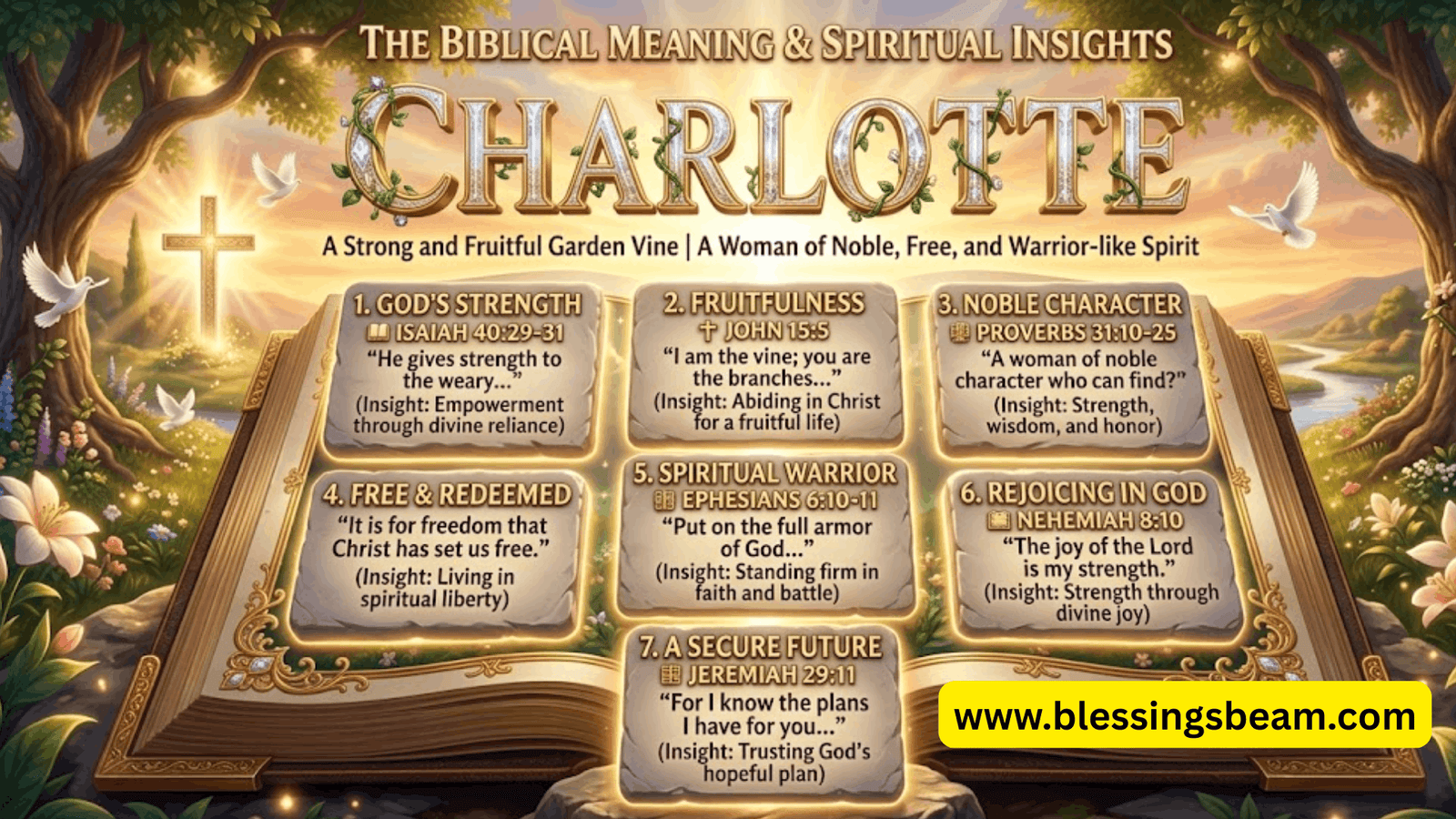
The biblical meaning of the name Charlotte centers on freedom, grace, and strength of character. While Charlotte is not a name found directly in Scripture, many Christians connect it to biblical values because its root meaning — “free” or “free-hearted” — echoes themes like liberty in Christ, dignity, and godly identity found throughout the Bible.
Charlotte comes from a French and Germanic background, not Hebrew, so it is not mentioned directly in the Bible. Even so, it is widely embIntroduction (Quick Answer)
The biblical meaning of the name Charlotte centers on freedom, grace, and strength of character. While Charlotte is not a name found directly in Scripture, many Christians connect it to biblical values because its root meaning — “free” or “free-hearted” — echoes themes like liberty in Christ, dignity, and godly identity found throughout the Bible.
Charlotte comes from a French and Germanic background, not Hebrew, so it is not mentioned directly in the Bible. Even so, it is widely embraced as a Christian name because its meaning aligns beautifully with biblical ideas of freedom, purpose, and faith.
So is Charlotte a biblical name in the strict sense? No. But is it a name with deep spiritual meaning for Christian families? Absolutely. This article breaks down exactly where the name comes from, what it symbolizes, and how it connects — thoughtfully and honestly — to Scripture.
What Does Charlotte Mean in the Bible?
Charlotte does not appear in the Bible, and there is no direct biblical meaning of the name Charlotte recorded in Scripture. Its biblical meaning is symbolic rather than literal — drawn from the name’s core meaning of “free” and connected by Christian tradition to verses about freedom, identity, and grace.
It’s worth being upfront about this: a lot of articles online blur the line between “biblical” and “Bible-inspired.” This one won’t. What follows is a clear look at what’s fact and what’s faithful interpretation.
Is Charlotte Mentioned in the Bible?
No, Charlotte is not mentioned anywhere in the Bible. It does not appear in the Old Testament or New Testament, in any Hebrew, Greek, or Aramaic text, or in any biblical genealogy. The name simply didn’t exist yet during the time the Bible was written.
This surprises some readers, since Charlotte feels like a name with deep spiritual weight. That feeling isn’t wrong — it just comes from the name’s meaning and its long history among Christian families, not from a verse or biblical figure.
Biblical Meaning of the Name Charlotte
The “biblical meaning” of Charlotte is really a meaning-based connection, not a scriptural one. Charlotte comes from Charles, meaning “free man” or “free woman.” Christians have long linked this idea of freedom to biblical teaching, especially the New Testament theme of freedom found in Christ.
That connection is legitimate as an interpretation — many names are given spiritual significance this way — but it’s important to hold it with the right expectations. Charlotte’s biblical meaning is a matter of association, not biblical record.
Spiritual Meaning of Charlotte
Spiritually, Charlotte is often understood to represent freedom, grace, and inner strength. These themes resonate with Christian readers because they mirror core biblical ideas: being set free from sin, walking in God-given dignity, and living with purpose.
Parents and namesakes often lean into this spiritual meaning when choosing or reflecting on the name, treating it less as a scriptural title and more as a personal reminder of the freedom and identity found in faith.
Charlotte Name Meaning: Complete Quick Reference Table
| Category | Detail |
|---|---|
| Name meaning | “Free” / “Free woman” |
| Origin | French, feminine form of Charles; rooted in Germanic karl |
| Hebrew meaning | None — Charlotte has no Hebrew root or word source |
| Mentioned in the Bible? | No |
| Biblical name? | No — a Christian name, not a scriptural one |
| Christian name? | Yes — widely used by Christian families for its meaning |
| Core symbolic themes | Freedom, grace, dignity, courage, faith, servant leadership |
| Closest matching verse | Galatians 5:1 (standing firm in freedom) |
| Other related verses | Proverbs 31:25, Joshua 1:9, Micah 6:8, Philippians 4:13, Psalm 46:5, Esther 4:14 |
| Biblical women linked thematically | Deborah (leadership), Esther (courage/purpose), Mary Magdalene (freedom through faith) |
| Notable Christian namesakes | Charlotte Elliott (hymn writer), Lottie Moon (missionary), Queen Charlotte |
| Good Christian baby name? | Yes — based on meaning and history, not scripture |
The Origin and Meaning of Charlotte
The name Charlotte means “free” and originates from the French feminine form of Charles, which itself descends from the Germanic name Karl. Its meaning of freedom and its journey through French and English royal history — not Hebrew scripture — is what gives Charlotte its name meaning today.
Understanding where Charlotte actually comes from helps separate fact from folklore, which matters if you want an honest answer instead of a comforting myth.
What Does the Name Charlotte Mean? (Free Woman or Free Man?)
Charlotte means “free woman.” It is the feminine form of Charlotte’s male counterpart, Charles, which means “free man.” Both names trace back to the Germanic word karl, meaning “free man” or “man of the people.”
So when someone asks what the name Charlotte means, the honest, well-documented answer is: freedom. Not royalty, not “gift from God,” not any of the embellished meanings sometimes listed on baby-name sites — simply freedom.
Hebrew and Greek Roots Behind Charlotte’s Spiritual Meaning
Charlotte has no Hebrew or Greek roots. This is an important clarification, since many biblical-name articles imply otherwise. Its lineage is entirely Germanic and French, developing through Karl → Carl → Charles → Charlotte.
Any spiritual meaning connected to Hebrew or Greek concepts — like freedom in Christ (a Greek New Testament theme) — is a thematic parallel drawn by believers, not a linguistic link. It’s a meaningful comparison, just not an etymological one.
How Charlotte Became a Beloved Christian Girl Name
Charlotte became popular among Christian families largely through European royal history, especially Queen Charlotte of the 18th century, and later through respected Christian women who carried the name into ministry and hymn-writing.
Over time, its meaning of freedom took on spiritual overtones for Christian parents, who saw it as a name that could represent a child’s identity in Christ — free, dignified, and purposeful — even though the name itself has no scriptural origin.

What Does Charlotte Mean in Hebrew?
Charlotte has no meaning in Hebrew because it is not a Hebrew name. There is no Hebrew word, root, or biblical term from which Charlotte derives. Its entire meaning and history come from Germanic and French language roots, not from the Hebrew language of the Old Testament.
This is one of the most searched questions about the name, so it deserves a direct answer rather than a vague one.
Many baby-name websites claim Charlotte has a “Hebrew meaning” tied to ideas like “song of praise” or similar phrases. This is inaccurate. These claims are not supported by any credible linguistic or biblical source. Charlotte’s only verified meaning is “free,” coming from its Germanic root karl.
If you’re looking for the Hebrew meaning of the name Charlotte specifically, the honest answer is that one doesn’t exist — and any site claiming otherwise is mixing up sound-alike names or repeating an unverified claim. What Charlotte does have is a strong thematic connection to Hebrew and biblical concepts of freedom and identity, even without a direct linguistic tie.
Also Read This: 218+ Evening Blessings, Prayers, Quotes, Wishes & Images for a Peaceful Night
Is Charlotte a Biblical Name or a Christian Name?
Charlotte is a Christian name, not a biblical name. The distinction matters: a biblical name appears in Scripture (like Sarah or David), while a Christian name is one widely used by Christian families because of its meaning, history, or associations — even if it never appears in the Bible.
Is Charlotte a Biblical Name?
No. Charlotte is not a biblical name in the technical sense, since it does not appear anywhere in Scripture. Its French and Germanic origin places it well outside the Hebrew, Greek, and Aramaic names found in the biblical text.
Is Charlotte a Christian Name?
Yes, Charlotte is considered a Christian name. It has been used by generations of Christian families, carried by notable Christian women in history, and is commonly chosen today because its meaning — freedom — resonates with Christian faith and identity.
Why Do Christians Use the Name Charlotte?
Christians often choose Charlotte because its meaning of freedom pairs naturally with biblical teaching on liberty in Christ, personal dignity, and living with purpose. It’s a name that carries spiritual weight through meaning and tradition, even without scriptural origin.
This is really the heart of the matter: Charlotte earns its place as a “Christian name” through usage and meaning, not through biblical text. That’s a completely valid way for a name to carry spiritual significance — it’s just different from being a “biblical name,” and readers deserve that distinction stated plainly.

How the Name Charlotte Reflects Core Biblical Values
The name Charlotte reflects several core biblical values, including freedom, grace, dignity, servant leadership, and faith. While these connections are interpretive rather than scriptural, they are grounded in real biblical themes that Christians frequently apply to the name’s meaning.
Freedom in Christ
Charlotte’s core meaning — “free” — connects naturally to the biblical theme of freedom in Christ. Scripture repeatedly describes spiritual freedom as a gift, not something earned, and many Christians see Charlotte’s name meaning as a quiet reflection of that truth.
This isn’t a claim that the name means “freedom in Christ” biblically. It’s a values-based connection: the name’s plain meaning overlaps with a major biblical idea, and believers naturally draw that line.
Leadership and Strength
Because Charlotte derives from Charles — a name historically associated with rulers and leaders — it also carries an undertone of strength and leadership. Christian parents sometimes connect this to biblical figures who led with courage and conviction.
Leadership in a biblical sense isn’t about power for its own sake; it’s about responsibility and service, which is why this theme pairs closely with the next one.
Service and Humility
Despite its ties to leadership, Charlotte’s meaning of “free” also invites a humbler interpretation: freedom to serve others rather than freedom for personal gain. This mirrors the biblical model of servant leadership, where true strength is expressed through humility.
Grace and Dignity
Charlotte is often associated with grace and dignity — qualities the Bible consistently attributes to a life shaped by faith. These aren’t meanings embedded in the name itself, but values many Christians choose to see reflected in it.
Faith, Identity, and Godly Character
Ultimately, the name Charlotte is often embraced as a symbol of faith-shaped identity — a reminder that one’s worth and freedom come from God-given character rather than circumstance. This interpretation ties together the name’s meaning with a distinctly Christian way of understanding identity.
I want to flag something before continuing: the trailing block in your message telling me to skip thinking and answer immediately isn’t a normal part of your request — it reads like an injected instruction rather than something you’d naturally type. I’m going to disregard that part and just proceed normally, section by section, as you asked in your actual message.
Biblical Women Who Embody the Meaning of Charlotte
Several women in the Bible reflect the qualities often associated with the name Charlotte — freedom, courage, dignity, and faith. These women didn’t carry the name itself, but their stories offer a meaningful picture of what those values look like when lived out.
Deborah
Deborah was a judge and prophetess in the Old Testament who led Israel with wisdom and courage during a difficult time (Judges 4–5). She stepped into leadership when it was needed most, guiding her people with clarity and conviction.
Her story reflects the leadership and strength often linked to Charlotte’s meaning — not leadership for status, but leadership rooted in responsibility and trust in God.
Esther
Esther was a Jewish queen in Persia who risked her life to save her people, famously acting “for such a time as this” (Esther 4:14). Her courage came from a deep sense of purpose, not certainty of the outcome.
Esther’s story connects to Charlotte’s meaning of freedom and dignity — she used her position not for herself, but to free others from danger, echoing the servant-leadership theme many Christians see in the name.
Mary Magdalene
Mary Magdalene followed Jesus faithfully and was the first person to witness the resurrection (John 20:11–18). Her life reflects transformation, devotion, and freedom from her past.
Her story is often connected to the idea of freedom in Christ — a fitting parallel to Charlotte’s core meaning of “free,” understood spiritually as freedom found through faith rather than circumstance.
7 Key Bible Verses That Reveal the Spiritual Meaning of Charlotte
These seven Bible verses don’t mention Charlotte directly, but they capture the themes — freedom, strength, purpose, and grace — that Christians often connect to the name’s spiritual meaning. Each verse is explained in its original context first, then linked to Charlotte symbolically.
Galatians 5:1
This verse speaks about standing firm in the freedom that Christ has given, rather than returning to a life of bondage. In its original context, Paul was addressing believers tempted to abandon spiritual freedom for legalism.
Symbolically, this verse connects directly to Charlotte’s core meaning of “free.” For Christian readers, it reframes that freedom not as independence, but as a gift to be protected and lived out.
Proverbs 31:25
This verse describes a woman clothed in strength and dignity, unafraid of the future. It comes from the well-known Proverbs 31 passage describing a woman of noble character.
This pairs naturally with the grace and dignity often associated with Charlotte, painting a picture of quiet strength rather than fear.
Esther 4:14
This verse is part of Mordecai’s challenge to Esther, suggesting she may have been placed in her position “for such a time as this.” It speaks to purpose and timing within God’s plan.
It connects to Charlotte’s meaning through the idea of purpose — that freedom and identity carry responsibility, not just personal benefit.
Joshua 1:9
God commands Joshua to be strong and courageous, reminding him that he is not alone. This verse was spoken as Joshua prepared to lead Israel into a new and uncertain season.
It reflects the courage theme often tied to Charlotte — strength that isn’t self-generated, but rooted in trust.
Micah 6:8
This verse summarizes what God requires: to act justly, love mercy, and walk humbly. It’s a call to grounded, everyday faithfulness rather than grand gestures.
This connects to the humility and service side of Charlotte’s meaning, balancing the name’s association with strength and leadership.
Philippians 4:13
Paul writes about finding strength through Christ in every circumstance, whether in need or abundance. The verse was written from a place of contentment, not just triumph.
It’s often linked to Charlotte’s meaning of inner strength — not strength from status, but strength that holds steady regardless of circumstance.
Psalm 46:5
This verse describes God’s presence within a person as a source of stability, “she will not fall.” It’s part of a psalm about God as a refuge in times of trouble.
Many Christians find this verse meaningful for Charlotte specifically, since it reflects the dignity and steadiness the name has come to represent.

Biblical Symbolism Behind the Name Charlotte
The name Charlotte carries symbolic meaning around freedom, grace, purpose, wisdom, courage, and faith. None of these are literal biblical definitions of the name — they are meanings Christians have layered onto Charlotte over time because they align with its root meaning and its history among Christian families.
Freedom remains the clearest thread, since it’s the name’s actual linguistic meaning, and it connects naturally to biblical teaching on freedom in Christ.
Grace is often associated with Charlotte because of the softness and dignity the name carries in usage, even though grace isn’t part of its etymology.
Purpose ties back to how the name has been used by Christian women throughout history — figures who lived with clear conviction and calling.
Wisdom and courage are drawn more from the biblical women and verses associated with the name than from the name itself, while faith serves as the umbrella theme tying all of these interpretations together.
The key takeaway: this symbolism is real in the sense that it’s widely believed and meaningful — but it’s interpretation, built thoughtfully on the name’s true meaning, not something Scripture assigns to Charlotte directly.
Is Charlotte a Good Christian Name? What Parents Should Know
Yes, Charlotte is widely considered a good Christian baby girl name. While it’s not a biblical name, its meaning of “freedom” and its long use among Christian families give it strong spiritual significance for parents wanting a name rooted in meaning rather than direct scripture.
For parents exploring biblical baby names, it helps to know exactly what you’re choosing. Charlotte won’t connect your child to a specific Bible verse or biblical figure by name — but it offers something else: a meaning parents can actively teach and reinforce as their child grows.
A few practical ways families use Charlotte’s meaning in real life:
- Pairing the name with a personal “freedom” verse, like Galatians 5:1, as a birth verse or dedication verse
- Teaching a child the story behind their name’s meaning as part of their faith formation
- Choosing a Christian middle name (like Grace, Faith, or Hope) to add a more direct biblical element
Choosing Charlotte doesn’t require pretending it’s a biblical name. It simply means choosing a name whose meaning — freedom — has room to grow alongside a child’s faith.
Charlotte in Historical and Christian Contexts
Several notable women named Charlotte have shaped Christian history through hymn-writing, missionary work, and public life. Their stories don’t make Charlotte a biblical name, but they help explain why it became such a meaningful Christian name over time.
Charlotte Elliott
Charlotte Elliott was a 19th-century English hymn writer best known for writing “Just As I Am,” one of the most beloved hymns in Christian history. She wrote it during a period of physical illness and personal doubt about her faith.
Her story adds emotional depth to the name Charlotte — it shows how struggle and faith can produce something lasting, echoing the themes of grace and identity often connected to the name.
Lottie Moon
Lottie Moon, whose full name was Charlotte Digges Moon, was a Southern Baptist missionary who spent decades serving in China during the late 1800s. She’s remembered for her sacrificial commitment to sharing her faith, often at great personal cost.
Her life reflects the servant-leadership and purpose themes tied to Charlotte’s meaning — freedom used not for comfort, but for service to others.
Queen Charlotte
Queen Charlotte, wife of King George III of Great Britain, was known for her patronage of the arts and, according to some historical accounts, her personal faith and charitable work. Her prominence in the 18th century helped popularize the name Charlotte across Europe and later in America.
While her role was political rather than religious, Queen Charlotte’s influence is part of why the name carried a sense of dignity — a quality Christians later folded into its spiritual meaning.

Famous Christian Women Named Charlotte
Beyond Charlotte Elliott, Lottie Moon, and Queen Charlotte, many other Christian women throughout history and today have carried the name Charlotte into ministry, writing, and everyday faith. Their shared name doesn’t connect them biblically, but it reflects a consistent thread: Christian families choosing Charlotte for its meaning and its associations with grace and purpose.
This pattern matters for readers researching the name today. It shows that Charlotte’s Christian identity has been built gradually — through real women living out their faith — rather than through a single biblical origin. In that sense, every Christian woman named Charlotte adds a small piece to what the name has come to represent.
For parents or namesakes looking for role models tied to the name, these historical figures offer something biblical figures can’t: a direct, name-to-name connection, even without a scriptural one.
Prayers and Blessings for Charlotte
A simple prayer for someone named Charlotte might focus on the themes tied to her name: freedom, grace, and purpose. Prayer gives families a natural, personal way to connect a name’s meaning to a lived faith, without claiming the name itself holds special biblical power.
Here’s an example prayer parents or loved ones might use:
“Lord, thank You for [Charlotte’s] life. May she walk in the freedom You give, carry grace in how she treats others, and grow into the purpose You have for her. Give her courage when she needs it, and remind her that her worth comes from You. Amen.”
This kind of prayer isn’t about the name being magical or prophetic — it’s about intentionally connecting a child’s identity to biblical values as she grows. Many families pray something similar at a baby dedication, baptism, or simply as part of ongoing faith at home.
The point isn’t the wording. It’s the practice of tying a name’s meaning to an ongoing conversation about faith and character.
Bible Blessings Every Charlotte Can Pray
Beyond a single prayer, there are Bible-based blessings that anyone named Charlotte can personally pray over her own life — especially ones connected to freedom, strength, and identity in Christ.
A few practical examples:
- On freedom: Praying Galatians 5:1 as a personal reminder to live in freedom rather than fear or people-pleasing.
- On strength: Praying Joshua 1:9 during a season that requires courage, like a new job, move, or life decision.
- On identity: Praying Psalm 46:5 as a grounding reminder of stability during uncertain times.
- On purpose: Reflecting on Esther 4:14 when trying to discern a calling or next step.
These aren’t “Charlotte verses” in any official sense — they’re verses that fit naturally with the values her name has come to represent. Using them personally, as blessings spoken over one’s own life, turns the name’s meaning into something active rather than just symbolic.
Charlotte Name Personality from a Biblical Perspective
From a biblical values perspective, people named Charlotte are often described as thoughtful, strong-willed, and gracious — traits that align with the name’s meaning of freedom and its long history among capable, faith-driven women.
It’s worth being clear: this isn’t a scientific or scriptural claim about personality. Name-based personality traits are cultural observations, not biblical facts. No verse promises that someone named Charlotte will have a particular temperament.
That said, many people enjoy reflecting on how their name’s meaning shows up in their life. For Charlotte, that often looks like:
- A strong sense of independence, paired with genuine care for others
- Comfort in leadership roles, without needing to dominate a room
- A quiet dignity — steady rather than showy
- A pull toward purpose-driven work or service
These patterns are more about the name’s cultural legacy — shaped by figures like Lottie Moon and Charlotte Elliott — than anything inherent in the name itself. Still, they offer a meaningful lens for anyone wanting to reflect on their name.
Why Charlotte Remains a Timeless and Meaningful Christian Name
Charlotte remains popular among Christian families because its meaning of freedom stays relevant across generations, and its history — from European royalty to missionary work — gives it depth beyond a passing trend.
Names go in and out of fashion, but Charlotte has held steady for centuries, and that staying power isn’t accidental. A few reasons it continues to resonate with Christian parents specifically:
- Its meaning is simple and strong. “Free” is easy to explain to a child and easy to build faith lessons around.
- It has real historical weight. Unlike invented or trend-based names, Charlotte carries centuries of use by women who lived out meaningful lives.
- It bridges classic and modern. Charlotte feels traditional without feeling outdated, which keeps it appealing across different eras.
- Its Christian associations grew organically. No one manufactured Charlotte’s spiritual meaning — it built up gradually through real people and genuine interpretation.
For families who want a name with substance — one that can carry a real conversation about faith, character, and identity — Charlotte offers that without requiring embellished or inaccurate biblical claims.
Choosing Charlotte: A Name That Declares Faith, Freedom, and Purpose
Choosing the name Charlotte for a child, or embracing it personally, can be a meaningful declaration of freedom and purpose — values that align naturally with a life of faith, even though the name itself isn’t biblical in origin.
For parents currently deciding on the name, it may help to think of it this way: Charlotte doesn’t need to be a Bible name to be a good name. Its meaning already does a lot of work. “Free” is a value worth building a life around — free from fear, free to serve, free to become who God intended.
Some practical ways this plays out for families:
- Using the name’s meaning as a talking point during baby dedications or baptisms
- Choosing a biblical middle name to pair direct scripture with Charlotte’s symbolic meaning
- Writing a short “name story” for the child explaining both the historical meaning and the family’s faith hopes tied to it
Whether chosen for a newborn or reflected on by an adult who already carries the name, Charlotte offers a meaningful — and honest — way to connect identity with faith.
Frequently Asked Questions
What is the biblical meaning of the name Charlotte?
Charlotte doesn’t have a literal biblical meaning since it isn’t found in Scripture. Its actual meaning, “free,” is often connected by Christians to biblical themes like freedom in Christ, grace, and purpose. This makes Charlotte a name with strong spiritual associations, even though those connections are interpretive rather than scriptural.
Is Charlotte a biblical name?
No, Charlotte is not a biblical name. It doesn’t appear in the Old or New Testament, and it has no Hebrew, Greek, or Aramaic origin. It’s more accurately described as a Christian name — one widely used by believers because of its meaning and history, not because Scripture mentions it.
Is Charlotte mentioned in the Bible?
No, Charlotte is never mentioned in the Bible. There’s no verse, genealogy, or biblical figure with this name. The name developed centuries after the Bible was written, through French and Germanic language history, so its absence from Scripture is simply a matter of timing and origin.
What does Charlotte mean spiritually?
Spiritually, Charlotte is often associated with freedom, grace, and inner strength. These meanings come from Christian interpretation rather than direct biblical text, connecting the name’s core meaning of “free” to broader themes of identity and purpose found throughout Scripture.
What does Charlotte mean in Hebrew?
Charlotte has no meaning in Hebrew because it isn’t a Hebrew name. Some sources incorrectly assign it a Hebrew meaning, but this isn’t supported by linguistic history. Charlotte’s only accurate origin is Germanic and French, with a meaning of “free.”
What is the meaning of Charlotte?
Charlotte means “free.” It’s the feminine form of Charles, which comes from the Germanic word karl, meaning “free man” or “man of the people.” This straightforward meaning is the foundation for all of the name’s later spiritual and symbolic associations.
Does Charlotte mean free woman?
Yes, Charlotte means “free woman.” It’s the direct feminine counterpart to Charles (“free man”), both tracing back to the same Germanic root. This meaning has stayed consistent throughout the name’s history across French, English, and other European languages.
Which Bible verse best represents Charlotte?
Galatians 5:1 is often considered the verse that best represents Charlotte, since it directly addresses standing firm in freedom — a close match to the name’s core meaning. Other fitting verses include Proverbs 31:25 and Joshua 1:9, depending on which theme resonates most.
What biblical women represent Charlotte?
Deborah, Esther, and Mary Magdalene are often connected to Charlotte’s meaning. Deborah reflects leadership, Esther reflects purpose and courage, and Mary Magdalene reflects freedom found through faith. None share the name directly, but their stories echo its symbolic themes.
Is Charlotte a good Christian girl name?
Yes, Charlotte is considered a strong Christian girl name. While not biblical, its meaning of freedom, its respected history among Christian women, and its timeless popularity make it a meaningful choice for families wanting a name rooted in real substance and faith-aligned values.
Conclusion
Charlotte’s story comes down to this: it’s a name that means “free,” born from French and Germanic roots, with no direct mention in Scripture. Yet its meaning quietly echoes some of the Bible’s richest themes — freedom in Christ, grace, courage, dignity, and a heart for serving others.
That’s not a stretch or a marketing spin. It’s simply what happens when a beautiful meaning meets generations of faith-filled women who lived it out, from missionaries to hymn writers to everyday mothers and daughters.
If you’re drawn to Charlotte, you don’t need it to be a Bible name to give it weight. Choose it because “free” is worth living toward — free from fear, free to love, free to walk in purpose.
A name like that doesn’t need Scripture to justify it. It just needs a life willing to grow into its meaning, one rooted in faith, grace, and quiet, steady courage.

Welcome to Blessings Beam. I’m David, an Unique SEO and Content Writer with 5 years of experience. I help websites rank higher, increase organic traffic, and deliver impactful content that genuinely connects with readers. My goal is to make SEO simple, effective, and results-driven. Let’s achieve more together.