
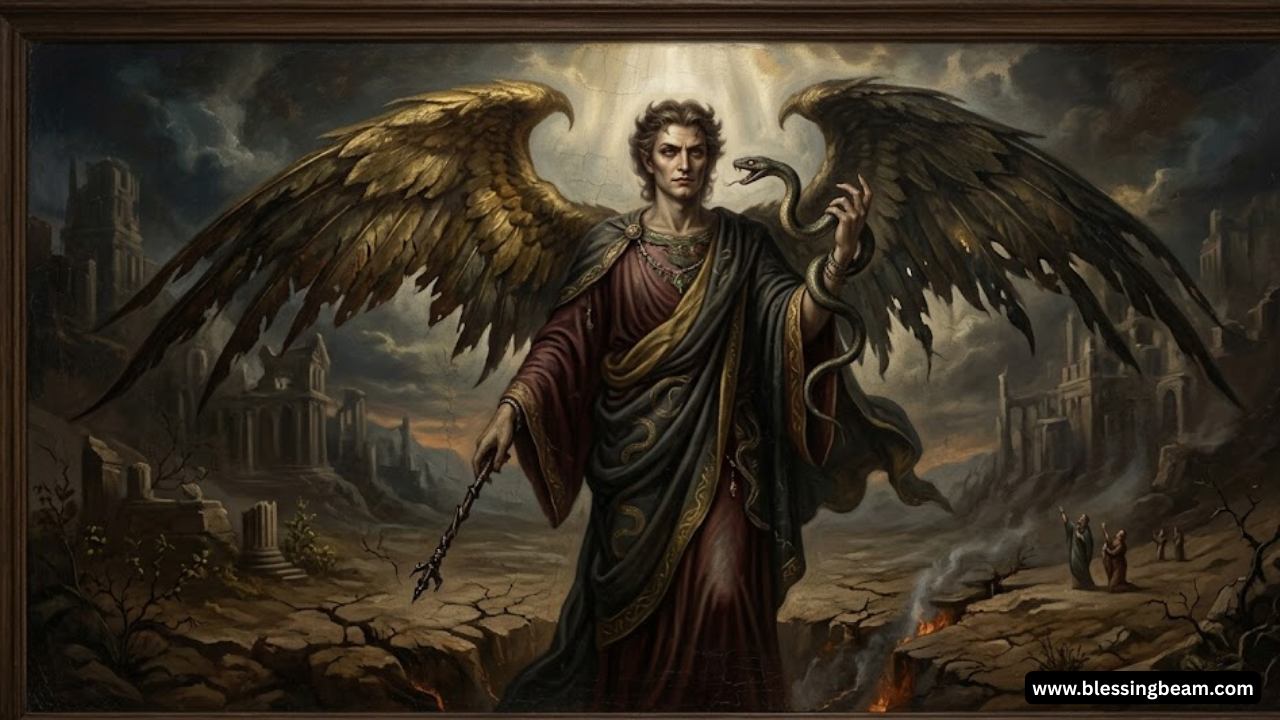
Most people picture Satan as a red creature with horns and a pitchfork. But the Bible paints a very different picture. The real Satan in Scripture is far more surprising than popular culture suggests.
The Bible describes Satan as a powerful and beautiful angel who fell from heaven. He is not a ruler of hell but an accuser who operates in the spiritual realm. His name literally means “adversary” in Hebrew, and his role is to oppose and test humanity.
Satan’s greatest weapon in the Bible is not fire or force. It is deception and lies. Jesus himself called Satan “the father of lies,” making his true danger not his appearance, but his ability to mislead and manipulate.
Understanding the Biblically Accurate Satan in Scripture
The Hebrew Concept of Ha-Satan
To truly understand Satan as the Bible presents him, we must begin with the original Hebrew language. The word “Satan” derives from the Hebrew term ha-satan, which carries the meaning of “the adversary,” “the accuser,” or “the one who opposes.” In ancient Hebrew legal culture, an adversary was someone who stood against another in a court of law, presenting charges and arguments. This is precisely the role ha-satan plays in the earliest biblical texts.
In the Book of Job, ha-satan appears among the “sons of God,” a phrase referring to heavenly beings or angels who present themselves before God. He is not cast out or condemned in this scene. Instead, he walks freely in God’s divine court and engages in direct dialogue with God. This portrayal is strikingly different from later Christian depictions of Satan as God’s enemy. In this early biblical context, ha-satan functions more like a prosecuting attorney than a cosmic villain.
The term is also used in other Old Testament passages in a non-personal way. In Numbers 22:22, the angel of the Lord stands as a “satan” to block the prophet Balaam, using the word as a common noun rather than a personal name. This shows that in early Hebrew thinking, “satan” described a role or function, not necessarily a unique evil being. The gradual transition from a functional title to a personal name reflects the evolution of Jewish theological thinking across centuries of religious development.
Understanding ha-satan in its original Hebrew context is essential because it prevents modern readers from importing later theological assumptions into earlier texts. The Old Testament portrait of Satan is more nuanced, more complex, and far less dramatic than what most people imagine. He is not yet the grand villain of Christian tradition. He is a heavenly functionary with a specific and divinely permitted role in testing and accusing humanity before God.
Satan’s Transformation Across Biblical Texts
One of the most fascinating aspects of studying Satan in Scripture is watching how his character and role develop across different books and time periods. This transformation is not accidental. It reflects the growing theological sophistication of the biblical writers as they wrestled with questions about the origin of evil, the nature of spiritual opposition, and the relationship between God and the forces that work against his purposes.
In the earliest Hebrew writings, ha-satan appears as a relatively neutral figure who serves within God’s divine council. He is a tester and an accuser, but he acts within the bounds of God’s authority. The Book of Job, widely considered one of the oldest texts in the Bible, presents this early version of Satan most clearly. He cannot act against Job without explicit divine permission, and he operates as a recognized member of the heavenly court.
As the Old Testament progresses into later writings, Satan begins to take on a more sinister character. In 1 Chronicles 21:1, Satan incites David to take a census of Israel, an act that brings divine punishment. This is a notable shift. Earlier in 2 Samuel 24:1, the same event is attributed to God’s anger moving David to act. The fact that the later Chronicler attributes the same event to Satan reveals an evolving theological understanding of evil and spiritual opposition that was developing within Jewish thought during and after the Babylonian exile.
By the time the New Testament was written, Satan had become a fully developed figure of spiritual opposition. Jesus speaks of Satan with clarity and authority, addressing him directly during the temptation in the wilderness, casting out demons in Satan’s realm, and declaring in Luke 10:18 that he witnessed Satan fall like lightning from heaven. The apostle Paul describes Satan as the ruler of the kingdom of the air, the spirit who works in the disobedient. The Book of Revelation presents him as the ancient serpent, the dragon, and the deceiver of the whole world who faces final defeat and eternal judgment.
This transformation across the biblical canon reflects not confusion or contradiction but a progressive revelation, a gradual unfolding of understanding about the nature and identity of the spiritual adversary that culminates in the comprehensive portrait found in the New Testament.
Also Read This: Biblically Accurate Lucifer: The Shocking Truth That Contradicts Everything You’ve Been Taught
Distinct Roles Across Old and New Testaments
The role Satan plays in the Old Testament differs significantly from his role in the New Testament, and recognizing these differences is key to developing a complete and accurate biblical understanding of the adversary. Rather than contradicting each other, these two distinct portraits work together to provide a full picture of Satan’s nature, function, and ultimate destiny.
In the Old Testament, Satan’s primary role is that of a tester and accuser. He appears in the divine court of Job and accuses Job of shallow faith, suggesting that Job only serves God because God has blessed him materially. God permits Satan to test Job by stripping away his blessings, and the result is a profound exploration of faith, suffering, and divine wisdom. Satan serves a purpose within God’s plan even as he opposes Job. Similarly, in Zechariah 3:1–2, Satan stands at the right hand of the high priest Joshua to accuse him before God. Again, the imagery is courtroom-like, with Satan functioning as a prosecuting voice.
In the New Testament, Satan’s role expands dramatically. He is no longer merely a heavenly accuser but an active spiritual force working against God’s kingdom on earth. He tempts Jesus in the wilderness for forty days, offering him earthly power in exchange for worship. He enters Judas Iscariot before the betrayal of Jesus, showing a more direct and possessive form of influence. He blinds the minds of unbelievers, according to 2 Corinthians 4:4, preventing them from seeing the light of the gospel. He prowls like a lion seeking someone to devour, according to 1 Peter 5:8.
Crucially, the New Testament also introduces the theme of Satan’s defeat and coming judgment. Jesus declares in John 12:31 that the ruler of this world will be driven out. Revelation 20 describes Satan being bound for a thousand years and ultimately thrown into the lake of fire. This eschatological dimension is largely absent from Old Testament texts and represents a major theological development in how the biblical story frames the adversary’s ultimate fate.

Characteristics of the Biblically Accurate Satan
Satan’s Functions and Symbolic Significance
The Bible assigns Satan several distinct functions that together create a comprehensive portrait of his role in spiritual reality. Understanding these functions helps believers engage with the concept of Satan in a way that is grounded in Scripture rather than shaped by cultural mythology. Each function reveals something important about how the adversary operates and what makes him genuinely dangerous.
Satan’s first and most foundational function is that of accuser. The name itself points to this role. In the heavenly courtroom imagery of both Job and Revelation, Satan brings charges against human beings. Revelation 12:10 calls him “the accuser of our brothers and sisters, who accuses them before our God day and night.” This function is not simply dramatic imagery. It reflects a deep theological truth about the nature of guilt, sin, and the need for divine advocacy. The New Testament response to this accusation is the intercessory work of Jesus Christ, who serves as our advocate before the Father.
Satan’s second function is that of tempter. He tests human beings by appealing to their desires, weaknesses, and ambitions. His temptation of Jesus in Matthew 4 is the clearest biblical example of this function. He offers bread to a hungry man, miraculous protection to a man of faith, and worldly power to the Son of God. Each temptation is carefully crafted to appeal to a legitimate human need or desire, twisted just enough to lead away from God’s path. This reveals that Satan’s temptations are rarely obviously evil. They often come dressed in reasonable or even appealing forms.
Satan’s third function is that of deceiver. Jesus declares in John 8:44 that Satan is the father of lies and that there is no truth in him. This function is arguably his most dangerous because it operates invisibly. Unlike accusation or temptation, deception works best when the victim does not know it is happening. Satan’s deception operates at the level of worldview, belief, and perception, shaping how people understand reality itself.
Symbolically, Satan represents the reality of moral opposition within a universe created by a good God. His existence in Scripture serves to explain why human beings face genuine spiritual resistance, why goodness is not automatic, and why faith requires active commitment and vigilance. He is not simply a literary device but a theological reality that gives shape and meaning to the biblical call to spiritual watchfulness.
Biblical Descriptions and Metaphorical Imagery
One of the most important corrections that biblical study offers to popular culture is in the area of Satan’s physical description. The Bible provides no physical description of Satan as a person with red skin, horns, a tail, or a pitchfork. These images come entirely from outside the biblical text. What Scripture does provide is a series of powerful metaphorical images that communicate truth about Satan’s nature far more effectively than any physical description could.
The most ancient metaphorical image of Satan in Scripture is the serpent of Genesis 3. The serpent who deceives Eve in the garden is cunning, patient, and subtle. He does not attack directly but asks questions, introduces doubt, and reframes God’s commands as oppressive restrictions. The New Testament connects this serpent explicitly to Satan. Revelation 12:9 calls Satan “that ancient serpent” who leads the whole world astray. This serpent imagery emphasizes Satan’s primary characteristic of deceptive cunning rather than brute force.
In 1 Peter 5:8, Satan is described as a roaring lion prowling around looking for someone to devour. This image communicates something entirely different from the serpent. Where the serpent is subtle and deceptive, the lion is predatory and relentless. This metaphor warns believers to stay alert and sober-minded, recognizing that spiritual danger is real and active. The lion does not announce its attack. It waits, circles, and strikes at moments of weakness and vulnerability.
Perhaps the most surprising biblical description of Satan comes from 2 Corinthians 11:14, where Paul writes that Satan disguises himself as an angel of light. This image is profoundly important for understanding how the adversary actually operates in the world. He does not always come as something obviously dark or frightening. He can appear beautiful, wise, and enlightened. This disguise makes him far more dangerous than any obvious monster could be, because people willingly open the door to something that appears good.
Revelation adds further imagery, calling Satan a great red dragon with seven heads and ten horns. This apocalyptic imagery is drawn from ancient Near Eastern mythology and is designed to communicate the terrifying scale of his power and opposition to God’s purposes. It is not meant to be taken as a literal physical description but as symbolic language conveying the magnitude of the spiritual conflict described in that prophetic book.
The Adversary’s Operational Boundaries
A critically important and often overlooked aspect of the biblical portrait of Satan is that he does not operate without limits. Scripture consistently presents Satan as a powerful but ultimately constrained being who functions within boundaries set by God. This truth is essential for a healthy theological understanding of evil and suffering and for maintaining a proper perspective on Satan’s actual power relative to God’s sovereignty.
The Book of Job establishes this principle most clearly. When Satan appears before God and proposes testing Job’s faith, God sets explicit boundaries. In Job 1:12, God tells Satan, “Everything he has is in your power, but on the man himself do not lay a finger.” Satan cannot go beyond what God permits. Later, when God allows Satan to afflict Job physically, he again sets a limit: “He is in your hands, but you must spare his life.” Satan, despite his desire to destroy Job completely, cannot cross the line God draws. This framework reveals that God remains sovereign even within the space where Satan is permitted to operate.
The New Testament reinforces this principle in various ways. In Luke 22:31–32, Jesus tells Simon Peter that Satan has asked to sift him like wheat, but Jesus has prayed for Peter that his faith will not fail. The very fact that Satan must ask or seek permission implies that he does not have unilateral authority over believers. His access to God’s people is mediated and limited by divine protection and the intercessory work of Christ.
Paul’s statement in 1 Corinthians 10:13 that God will not allow believers to be tempted beyond what they can bear also implies a divine limit on Satan’s ability to overwhelm those who belong to God. James 4:7 offers a direct promise that if believers resist the devil, he will flee. This would be an empty promise if Satan were truly unlimited in his power and persistence.
Understanding Satan’s operational boundaries transforms how believers relate to the concept of spiritual opposition. Rather than living in fear of an all-powerful enemy, Scripture calls believers to live with confident awareness that they serve a God who is infinitely greater than the adversary and who carefully governs even the space where evil is permitted to operate.
Deception as Primary Tactic
If one characteristic defines Satan’s strategy more than any other in Scripture, it is deception. The Bible consistently presents Satan not as a being of overwhelming power who crushes believers into submission but as a master deceiver who works through lies, distortions, half-truths, and carefully crafted illusions. Understanding this emphasis on deception is crucial for believers who want to engage with the reality of spiritual opposition in a way that is both biblically accurate and practically useful.
The foundational text for Satan’s identity as a deceiver is John 8:44, where Jesus speaks to religious leaders who are opposing him and says, “You belong to your father, the devil, and you want to carry out your father’s desires. He was a murderer from the beginning, not holding to the truth, for there is no truth in him. When he lies, he speaks his native language, for he is a liar and the father of lies.” This statement from Jesus himself is the clearest and most authoritative description of Satan’s essential nature. Lying is not something Satan does occasionally. It is his native language, the fundamental orientation of his being.
Satan’s deception in Scripture operates at multiple levels. At the most basic level, he deceives individuals about the nature of sin, making what is harmful appear desirable and what is good appear restrictive. This is exactly what he does in Genesis 3, where he tells Eve that eating the forbidden fruit will not bring death but will make her like God. The lie is not entirely obvious. It contains enough truth to be believable. God did say they would gain knowledge of good and evil. But the critical element of the consequence, spiritual death and separation from God, is carefully omitted.
At a broader level, Satan deceives whole populations and cultures. Paul writes in 2 Corinthians 4:4 that the god of this age has blinded the minds of unbelievers so that they cannot see the light of the gospel. This large-scale deception operates through false philosophies, counterfeit religions, and cultural assumptions that lead people away from truth. Revelation describes Satan as the one who deceives the whole world, suggesting a scope of influence that extends far beyond individual temptation into the shaping of entire civilizations.
The practical implication of Satan’s deceptive nature is that believers cannot rely solely on their feelings or perceptions to navigate spiritual reality. Scripture consistently calls believers to test everything against the word of God, to be transformed by the renewing of their minds, and to put on the full armor of God, which includes the belt of truth. Truth is specifically named as the primary defense against the one whose fundamental nature is the lie.

Biblical Versus Cultural Depictions of Satan
Literary and Artistic Influences on Satan’s Image
The gap between the biblically accurate Satan and the Satan of popular imagination is enormous, and understanding how that gap developed is both historically fascinating and theologically important. The Satan most people picture today is largely the product not of careful Bible reading but of literary and artistic creativity stretching back many centuries. Two works of literature above all others have shaped the Western world’s visual and emotional understanding of the devil far more than Scripture itself has.
John Milton’s Paradise Lost, published in 1667, is arguably the single most influential literary work in shaping how English-speaking cultures understand Satan. Milton’s Satan is a magnificent, tragic figure, a being of immense pride and eloquence who declares it better to reign in hell than serve in heaven. He is given heroic qualities, complex psychology, and powerful speeches that make him one of the most memorable characters in all of English literature. Milton’s Satan is charismatic, intelligent, and almost sympathetic, qualities that have little direct basis in biblical texts but enormous cultural staying power.
Dante Alighieri’s Divine Comedy, written in the early fourteenth century, contributed a very different but equally influential image. In Dante’s Inferno, Satan is a gigantic frozen figure trapped at the center of hell, endlessly chewing on the bodies of the greatest traitors in history. This image places Satan firmly as the ruler of hell, presiding over eternal punishment, an idea that has become deeply embedded in popular Christianity despite having minimal direct biblical support. The Bible’s actual description of hell and Satan’s role in it is far more limited and eschatological in nature.
These literary works, combined with centuries of theological commentary, sermons, and moral teaching, created a cultural Satan that bears only a distant relationship to the biblical figure. The literary Satan is dramatic, independent, powerful, and personally compelling. The biblical Satan is dangerous precisely because he is subtle, constrained, and works not through dramatic confrontation but through quiet deception and patient manipulation.
Historical Development of Visual Representations
The visual image of Satan, complete with horns, hooves, a tail, red skin, and a pitchfork, did not emerge from careful reading of biblical texts. It developed gradually across many centuries through a fascinating process of cultural blending, artistic convention, and theological imagination. Tracing this development reveals how profoundly non-biblical the familiar Satan image actually is.
The earliest Christian art did not depict Satan in the familiar horned form. In the catacombs and early church art, Satan was often shown simply as a serpent or in relatively human form. The dramatic horned devil emerged largely through the medieval period, when Christian artists began appropriating and reinterpreting imagery from pre-Christian European religions. The horns and hooves of Pan, the Greek god of nature and wild places, were gradually transferred to the figure of Satan, creating a hybrid image that communicated primal fear and animal wildness while signaling the pagan origins of evil.
Medieval mystery plays, performed publicly throughout Europe, required actors to portray Satan in recognizable and theatrical ways. Costumes were developed that emphasized his monstrous and frightening nature, complete with elaborate masks, horns, and theatrical fire effects. These performances reached enormous audiences across many generations and cemented the visual Satan in popular imagination far more effectively than any theological treatise could.
The color red became associated with Satan through a combination of associations with fire, blood, danger, and the red dragon imagery of Revelation. By the late medieval and Renaissance periods, the composite image of the red-skinned, horned, pitchfork-wielding devil had become so culturally dominant that it was virtually indistinguishable from religious belief itself, even though its actual biblical basis was essentially nonexistent.
Modern Media’s Portrayal of the Adversary
Contemporary media has inherited and amplified the cultural Satan while adding new dimensions shaped by modern storytelling conventions, psychological sophistication, and commercial entertainment values. The Satan of film, television, and popular music bears little resemblance to the biblical figure but reveals much about the cultural anxieties and values of each era in which these portrayals are produced.
Hollywood has produced an enormous variety of Satan portrayals, ranging from the terrifying supernatural figure of horror films to the charming, witty dealmaker of comedies. Films like The Exorcist emphasize demonic possession and physical horror. Others like The Devil’s Advocate present Satan as a powerful, seductive businessman played by Al Pacino with charismatic brilliance. Television series like Lucifer have reimagined the devil as a sympathetic protagonist, a charming nightclub owner who helps solve crimes while grappling with questions of free will and identity. Each of these portrayals says something interesting about cultural attitudes toward evil, but none of them are attempting serious biblical theology.
Popular music, particularly in rock and heavy metal traditions, has used Satanic imagery extensively as a symbol of rebellion against authority, religious hypocrisy, and social conformity. For many artists, Satan is not a theological reality but a cultural symbol of freedom from constraint. This usage further muddies the waters for those seeking to understand what Scripture actually teaches, because the symbol becomes so loaded with cultural meaning that its biblical origins become almost irrelevant.
Social media and internet culture have added yet another layer, producing countless memes, aesthetic movements, and online communities that engage with Satanic imagery in ways ranging from ironic humor to genuine alternative spirituality. The Satanic Temple, a prominent modern organization, uses Satan explicitly as a symbol of individual liberty and opposition to religious overreach rather than as a being they literally worship, further demonstrating how far the cultural figure has traveled from its biblical origins.
Key Differences Between Scripture and Culture
When we place the biblical Satan directly beside the cultural Satan, the differences are striking and significant. These differences matter not only for theological accuracy but for how believers understand spiritual reality, respond to evil, and maintain healthy spiritual lives.
The most fundamental difference is ontological. The biblical Satan is a created spiritual being operating under divine sovereignty with real but limited power. The cultural Satan is often portrayed as an autonomous ruler with independent power over a vast spiritual kingdom, an almost equal and opposite force to God himself. This dualistic portrait, while dramatically satisfying, contradicts the clear biblical testimony that God alone is sovereign and that Satan operates only within divinely permitted boundaries.
The biblical Satan does not rule hell as his kingdom. The Bible presents hell as a place of divine judgment, not Satan’s domain where he presides over torture. Revelation 20 describes Satan himself being thrown into the lake of fire, meaning hell is his place of punishment, not his palace of power. The popular image of Satan ruling hell with a pitchfork gets the relationship between Satan and hell almost exactly backwards.
The biblical Satan works primarily through deception and operates in the spiritual realm. The cultural Satan appears physically, makes deals, rules visibly, and confronts people directly. The biblical Satan disguises himself as an angel of light. The cultural Satan announces himself with dramatic flair. These opposite approaches reveal a fundamental misunderstanding of how the biblical adversary actually operates, making the cultural depiction not just inaccurate but potentially counterproductive for believers trying to recognize genuine spiritual danger.

The Lucifer Debate: Biblically Accurate Analysis
Etymology and Translation History
Few topics in biblical studies generate as much confusion as the name Lucifer and its relationship to Satan. The word Lucifer does not appear in the original Hebrew or Greek texts of the Bible. It entered the biblical story through the Latin Vulgate translation produced by Jerome in the late fourth century. Understanding this translation history is essential for evaluating the popular identification of Lucifer with Satan.
The Hebrew word in question is helel, which appears once in the entire Old Testament, in Isaiah 14:12. The word comes from a root meaning to shine brightly and is often translated as “shining one,” “son of the dawn,” or “morning star.” Jerome translated this Hebrew word into Latin as lucifer, which was a common Latin term meaning “light-bearer” or “bringer of light.” In the ancient Roman world, lucifer was also a name for the planet Venus when it appeared before sunrise as the morning star. It was an ordinary Latin word with no inherently evil connotations.
When early English translators worked from the Latin Vulgate, they transliterated the Latin word lucifer directly into English rather than translating it, creating the impression that Lucifer was a proper name. The King James Version of 1611 preserved this transliteration in Isaiah 14:12, cementing Lucifer as a name in the English-speaking Christian consciousness. Modern translations like the New International Version, the English Standard Version, and others translate the underlying Hebrew more accurately, rendering the phrase as “morning star,” “shining star,” or “son of the dawn” rather than preserving the Latin loan word.
The theological weight placed on the name Lucifer in popular Christianity, as Satan’s original heavenly name before his fall, rests entirely on this translation history rather than on any direct biblical statement connecting the name to the adversary’s personal identity.
Isaiah 14: Addressing Babylon’s King
Isaiah 14 is the chapter at the center of the Lucifer debate, and reading it carefully in its full context reveals that the primary reference of this passage is not to Satan at all but to the king of Babylon. Understanding the context, purpose, and literary genre of this chapter is essential for any honest engagement with the question of Lucifer’s identity.
The passage begins clearly in Isaiah 14:3–4: “On the day the Lord gives you relief from your suffering and turmoil and from the harsh labor forced on you, you will take up this taunt against the king of Babylon.” What follows is a poetic taunt, a mocking lament over the fall of a proud and powerful human ruler. The literary genre is what scholars call a “taunt song,” a form of victory poetry that celebrates the downfall of an enemy by dramatically describing their humiliation.
Within this taunt song, the poet employs elevated mythological imagery drawn from the cultural context of the ancient Near East. The language of falling from heaven, being cut down to earth, and descending to the realm of the dead reflects common ancient poetic conventions for describing the rise and fall of powerful rulers. The phrase “son of the dawn” or “morning star” was likely a royal title used in the ancient Near East, applied to kings who claimed divine status or cosmic significance.
The identification of this passage with Satan requires reading a meaning into the text that is not explicitly stated within the chapter itself. The entire chapter from beginning to end is addressed to the king of Babylon and describes his earthly rise, his arrogant claims to divine status, and his humiliating fall into death. While some theologians argue that the language is too exalted for a mere human ruler and must refer to a supernatural being, others argue that this kind of hyperbolic language was entirely normal in ancient Near Eastern poetry about kings and empires.
Ezekiel 28: The Tyre Connection
Ezekiel 28 presents a similar interpretive challenge to Isaiah 14. The chapter contains a lament over the prince and king of Tyre, a powerful Phoenician city-state, and uses language so exalted and supernatural in tone that many theologians have argued it must refer to Satan rather than to any human ruler. Examining this passage carefully reveals both why this interpretation has appeal and why it remains a matter of genuine scholarly debate.
The chapter begins with a straightforward oracle against the human ruler of Tyre, condemning him for his pride and his claim to be a god rather than a mortal. But beginning in verse 12, the language shifts in a remarkable direction. The text speaks of a being who was “the seal of perfection, full of wisdom and perfect in beauty.” It describes this figure as having been in Eden, the garden of God, adorned with precious stones. It says this being was an anointed guardian cherub who was on the holy mountain of God, walking among the fiery stones, and was blameless from the day he was created until wickedness was found in him.
Those who interpret this passage as referring to Satan argue that no human king of Tyre could be described as having been in Eden, as being a guardian cherub, or as having been created in perfection. They see this language as reaching through the human king to the supernatural being, Satan, who was working behind the scenes of Tyrian pride and corruption.
Those who interpret the passage as referring solely to the human king argue that the entire chapter is structured as an address to the king of Tyre and that the elevated mythological language was a standard literary device for describing the greatness and subsequent fall of powerful rulers. They note that comparing a proud king to a being who dwelled in paradise and fell from glory would have been a powerful rhetorical choice regardless of whether it literally described a historical supernatural fall.
Both interpretations deserve serious engagement. What is clear is that Ezekiel 28, like Isaiah 14, is not primarily a theological treatise about Satan’s origins. It is prophetic poetry addressed to a human political situation, and any conclusions about Satan drawn from it must be held with appropriate interpretive humility.
Development of the Satan-Lucifer Association
The explicit and direct identification of Lucifer with Satan developed not within the pages of Scripture itself but through the interpretive work of early Christian theologians and church fathers who read Isaiah 14 and Ezekiel 28 as references to Satan’s primordial rebellion and fall. Tracing this interpretive development helps explain why the Satan-Lucifer association became so deeply embedded in Christian tradition even though it rests on inferential rather than direct biblical evidence.
Origen of Alexandria, one of the most influential early Christian theologians writing in the third century, interpreted Isaiah 14:12 as a reference to Satan’s fall from heaven. Tertullian, writing around the same period, similarly applied the passage to the devil. These were brilliant and respected thinkers whose interpretations carried enormous weight in shaping subsequent Christian theology. Their reading of Isaiah 14 as referring to Satan became the dominant Christian interpretation and was transmitted through centuries of theological commentary.
By the medieval period, the identification was so firmly established in Christian tradition that it was virtually unquestioned. Lucifer became the standard name for Satan in his pre-fallen state, and the story of his pride-driven rebellion against God became a cornerstone of Christian cosmology. Milton’s Paradise Lost drew on this tradition extensively, giving it dramatic and literary expression that further cemented it in Western culture.
The twentieth century saw the beginning of more critical engagement with this traditional identification. As biblical scholarship developed more sophisticated tools for understanding ancient literary genres, historical contexts, and translation histories, some scholars began to question whether Isaiah 14 and Ezekiel 28 were really about Satan at all or whether they had been read through a theological lens that their original authors would not have recognized. This debate continues in contemporary biblical scholarship, making the Lucifer question one of the most interesting and contested areas in the study of Satan in Scripture.
Jesus’s Statement on Satan’s Origin
While the Lucifer debate remains a matter of interpretive disagreement, the New Testament provides its own testimony about Satan’s origin and fall that deserves careful examination. The most direct statement comes from Jesus himself in Luke 10:18, where he tells his disciples who have just returned from a successful ministry trip: “I saw Satan fall like lightning from heaven.”
This statement is remarkable for several reasons. First, it implies that Jesus personally witnessed Satan’s expulsion from heaven, suggesting a divine perspective on cosmic history that precedes the incarnation. Second, the imagery of falling like lightning communicates both speed and finality, suggesting a decisive and dramatic removal from the heavenly realm. Third, Jesus speaks of this fall in the past tense, indicating that Satan’s expulsion from heaven was a completed historical event rather than a future expectation.
The context of this statement is significant. Jesus makes it in response to his disciples’ excitement that even demons submit to them in Jesus’s name. Jesus connects their successful ministry against demonic forces to the broader cosmic reality of Satan’s fall, suggesting that what the disciples are experiencing in their ministry is a manifestation of a larger spiritual reality in which Satan’s power has been decisively challenged and limited.
Some theologians interpret Luke 10:18 as referring to Satan’s original primordial fall before human history began. Others argue that Jesus is speaking prophetically about Satan’s defeat being accomplished through the ministry of Jesus himself, with the disciples’ successful mission serving as a sign of that coming defeat. Still others see it as a reference to a specific moment during Jesus’s earthly ministry when Satan’s cosmic authority was particularly challenged.
Regardless of which interpretation one finds most convincing, Jesus’s statement in Luke 10:18 provides the clearest New Testament evidence for the concept of Satan having undergone a significant fall or expulsion from the heavenly realm, lending support to the broader theological tradition of Satan as a fallen heavenly being even if the specific connection to Isaiah 14’s “morning star” language remains debated.

Theological Understanding of the Biblically Accurate Satan
Satan’s Function in Biblical Narratives
Within the grand narrative arc of Scripture, Satan plays a carefully defined theological function that serves the larger story of God’s redemptive purposes. Understanding this narrative function helps believers engage with the concept of Satan in a way that is both intellectually serious and spiritually productive. Rather than viewing Satan as an embarrassing or primitive element of biblical theology, we can recognize him as a theologically significant figure whose presence in the story illuminates crucial truths about God, humanity, freedom, and redemption.
Satan’s most fundamental narrative function is to represent genuine moral opposition within a universe created by a good God. The existence of a real adversary explains how a world made by a perfectly good Creator can contain genuine evil without placing the responsibility for that evil on God himself. Satan’s rebellion and his ongoing opposition to God’s purposes provides a framework for understanding the origin of evil that preserves both God’s goodness and the reality of genuine moral freedom.
In specific narratives, Satan serves to test and reveal the true nature of faith. The testing of Job is the clearest example. Without Satan’s challenge, the question of whether Job’s faith was genuine or merely self-serving would never have arisen. The suffering that Satan brings becomes the crucible in which the reality and depth of Job’s commitment to God is revealed and ultimately vindicated. Similarly, Satan’s temptation of Jesus in the wilderness serves to reveal the absolute integrity of Christ’s commitment to his Father’s will and to establish that Jesus overcomes where Adam failed.
Satan also functions in biblical narratives as the ultimate context for the significance of Christ’s work. The New Testament presents the death and resurrection of Jesus as a decisive victory over the power of sin, death, and the devil. Hebrews 2:14 states that Jesus became human so that by his death he might break the power of him who holds the power of death, that is, the devil. Without Satan as a genuine spiritual reality, the cosmic dimensions of what Christ accomplished on the cross lose much of their meaning and magnitude.
Detailed Examination of Key Passages
Several key biblical passages provide the most direct and substantive information about Satan’s nature, activities, and ultimate destiny. Examining these passages in detail, with attention to their context and literary character, builds a comprehensive and accurate biblical portrait of the adversary.
Job 1–2 establishes the foundational portrait of Satan as a being who operates within God’s sovereign authority. The divine council scene, where Satan presents himself before God and receives permission to test Job, reveals that Satan is not autonomous. He must seek access, accept limits, and ultimately cannot overcome the faith of a believer whom God protects. This passage is essential for understanding that Satan’s power, however real, is always derivative and constrained.
Zechariah 3:1–5 presents Satan in his role as accuser in a brief but powerful vision. The high priest Joshua stands before the angel of the Lord while Satan stands at his right hand to accuse him. God rebukes Satan and declares Joshua clean, replacing his filthy garments with rich robes. This passage beautifully illustrates both Satan’s accusatory function and the divine response of grace that overcomes his accusations.
Matthew 4:1–11 provides the most detailed account of Satan’s activity against a specific individual in the entire New Testament. The threefold temptation of Jesus reveals Satan’s strategy, his knowledge of Scripture, his use of legitimate desires twisted in illegitimate directions, and his willingness to offer genuine earthly power in exchange for worship. Jesus’s threefold response using Scripture demonstrates the primary spiritual weapon against Satan’s temptations.
Ephesians 6:10–18 provides Paul’s comprehensive framework for spiritual warfare in the context of satanic opposition. The passage calls believers to put on the full armor of God because the struggle is not against flesh and blood but against rulers, authorities, powers of this dark world, and spiritual forces of evil in the heavenly realms. Each piece of armor corresponds to a specific aspect of Satan’s strategy and a specific spiritual resource available to believers.
Revelation 12 and 20 provide the eschatological bookends of Satan’s story within Scripture. Chapter 12 describes Satan as the great dragon who is thrown out of heaven after a cosmic battle with Michael and his angels. Chapter 20 describes his binding during the millennium, his brief release, his final defeat, and his eternal judgment in the lake of fire. These chapters establish that Satan’s story, however long and dramatic, has a definitive and decisive ending within God’s sovereign plan.
Interpretations Across Christian Traditions
While all major Christian traditions accept the reality of Satan as a personal spiritual being, they differ significantly in how they understand his nature, his power, his current activities, and the appropriate Christian response to his influence. These differences reflect broader theological commitments and hermeneutical approaches that have developed across centuries of Christian thought.
The Roman Catholic tradition has developed the most systematic theological treatment of Satan, drawing on the work of theologians like Thomas Aquinas and the official teaching of the Catechism. Catholic theology affirms Satan as a fallen angel whose power is real but limited, who was definitively defeated by Christ’s passion, and whose ultimate judgment is certain. The Catholic tradition also maintains practices of exorcism and formal rites of deliverance that assume a direct and sometimes dramatic engagement with demonic forces.
Protestant traditions vary considerably in their approach to Satan. Reformed and Calvinist theologies tend to emphasize God’s absolute sovereignty in ways that limit Satan’s effective power and stress that believers need not fear him unduly. Arminian traditions give somewhat more emphasis to the genuine freedom of both Satan and human beings to act against God’s desires. Charismatic and Pentecostal traditions tend to place the greatest emphasis on direct spiritual warfare against demonic forces, often developing elaborate frameworks for understanding territorial spirits, generational curses, and the mechanics of spiritual conflict.
Eastern Orthodox theology approaches Satan within the framework of theosis, the process of human beings being transformed into ever-greater likeness to God. In this framework, Satan is primarily the enemy of human transformation and divine participation, and the primary response to his influence is not confrontational spiritual warfare but deepening communion with God through prayer, sacrament, and ascetic practice.
Liberal and progressive Christian traditions vary widely, with some maintaining a traditional understanding of Satan as a personal being and others interpreting him symbolically as a representation of systemic evil, human cruelty, or the capacity for self-deception that exists within individuals and societies. These more symbolic interpretations often struggle to engage adequately with biblical texts that present Satan as a personal agent with specific intentions and activities.

Comparative Religious Perspectives on the Biblically Accurate Satan
Jewish Understanding of Ha-Satan
The Jewish understanding of ha-satan differs significantly from Christian interpretation in ways that are historically important and theologically illuminating. While Christianity developed Satan into a central figure of cosmic evil and the primary spiritual enemy of believers, mainstream Jewish theology retained a more limited and functional understanding of the adversary that stayed closer to the portrait found in the earlier Hebrew texts.
In classical rabbinic Judaism, ha-satan is often understood as identical with the yetzer ha-ra, the evil inclination that exists within every human being. Rather than being an external supernatural entity, Satan is internalized as the voice of temptation, selfishness, and moral weakness that every person must struggle against. This psychological interpretation of Satan significantly changes his theological function. He becomes not a cosmic enemy to be resisted through spiritual warfare but an internal dimension of human nature to be disciplined and redirected through Torah observance, prayer, and ethical living.
The Talmud contains various references to ha-satan that present him in his prosecutorial role as an accuser before the divine court. Yom Kippur, the Day of Atonement, is connected in rabbinic tradition to the neutralization of ha-satan’s power to accuse, with the gematria value of ha-satan being numerically equivalent to 364, suggesting he has power to accuse on every day of the year except Yom Kippur. This playful numerical interpretation reveals how differently the rabbinic tradition engaged with the concept of Satan compared to Christian theological tradition.
Kabbalistic Judaism developed a more elaborate understanding of Satan and demonic forces, placing them within the complex mystical framework of the sefirot and the cosmic battle between divine light and the forces of impurity. In Kabbalistic thought, Satan is associated with the realm of the sitra achra, the “other side,” representing the spiritual forces of darkness and impurity that stand in opposition to divine holiness. This Kabbalistic Satan is more similar to the Christian conception of a powerful spiritual adversary but remains embedded in a very different cosmological framework.
Islamic Conception of Iblis
The Quran presents a figure who closely parallels the biblical Satan in the form of Iblis, whose story provides important points of comparison and contrast with the biblical portrait of the adversary. The Islamic account of Iblis is both similar to and significantly different from the Christian understanding of Satan, reflecting the distinct theological commitments of Islamic thought.
In the Quranic account, Iblis was a being of great devotion and spiritual standing who was present in the heavenly realm when God created Adam. When God commanded all the angels and heavenly beings to bow in honor before the newly created human, Iblis refused. His stated reason was pride and a claim of superiority: he was created from fire, while Adam was created merely from clay, making him inherently superior and the prostration therefore inappropriate. This act of proud disobedience led directly to his expulsion from God’s presence.
Unlike the Christian Satan, Iblis in the Quran does not rebel against God’s authority in any grand cosmic sense. He accepts that God is sovereign and all-powerful and does not attempt to dethrone God or establish a rival kingdom. Instead, he asks God for respite until the Day of Resurrection, requesting time to prove that human beings are unworthy of the honor God has shown them. God grants this request, and Iblis becomes Shaytan, the tempter who works to lead human beings astray through deception and the appeal to pride and desire.
The Islamic Shaytan, like the biblical Satan, works primarily through whispering temptation and deception rather than through direct power. He has no ability to compel human beings but can only suggest and entice. The Quran emphasizes that Shaytan’s power over those who trust in God is genuinely limited, and that seeking God’s protection through the phrase a’udhu billahi min al-Shaytan al-rajim provides genuine spiritual protection against his influence.
Cross-Tradition Comparative Analysis
When we examine the concept of Satan or the adversary across Judaism, Christianity, and Islam, we find both significant areas of overlap and important theological differences that reflect each tradition’s distinct understanding of God, human nature, and the nature of spiritual opposition. This comparative analysis enriches our understanding of each tradition’s specific claims while revealing the common human questions about evil and opposition that these different theological answers are attempting to address.
All three traditions affirm that there exists a spiritual being or force of adversarial opposition that works against human beings’ relationship with God and their moral and spiritual flourishing. All three traditions affirm that this adversary works primarily through deception, temptation, and the appeal to human pride and desire. All three traditions affirm that God’s power is ultimately greater than the adversary’s power and that divine protection is available to those who seek it. These common elements suggest a shared human experience of moral struggle and spiritual resistance that each tradition interprets through its own theological framework.
The differences are equally instructive. Christianity gives Satan the most developed and cosmologically significant role of the three traditions, making him a central figure in the cosmic drama of fall and redemption whose defeat is one of the primary achievements of Christ’s work. Judaism generally resists this level of cosmic dualism and prefers to keep ha-satan in a more limited and functional role that preserves God’s absolute sovereignty more completely. Islam similarly resists cosmic dualism but develops the Iblis narrative in ways that emphasize the specific sin of pride against God’s creative purposes and human dignity.
These differences in the significance and function of the adversary figure reflect deeper theological commitments in each tradition. Christianity’s strong emphasis on Satan reflects its doctrine of cosmic redemption accomplished in Christ. Judaism’s more limited Satan reflects its emphasis on Torah observance and human moral responsibility. Islam’s Iblis narrative reflects its theological commitment to absolute divine sovereignty and the specific human calling to fulfill the role of God’s vicegerent on earth.
Zoroastrian Influence on Development
The question of whether Zoroastrian religious ideas influenced the development of the biblical concept of Satan is a genuinely important and debated topic in the history of religions. Zoroastrianism, the ancient Persian religion founded by the prophet Zoroaster, developed one of the world’s earliest and most elaborate systems of cosmic dualism, positing an eternal battle between a supreme good deity, Ahura Mazda, and a supreme evil being, Angra Mainyu or Ahriman. Understanding the possible relationship between this framework and the development of the biblical Satan requires careful historical and theological analysis.
The historical context that makes this influence plausible is the Babylonian exile of the Jewish people in the sixth century BCE. During this period, Jews lived under Babylonian and then Persian rule for several generations. The Persian Empire, which conquered Babylon and permitted the Jewish return to Israel, was a Zoroastrian culture. This extended contact between Jewish religious thinkers and Zoroastrian religious ideas created conditions in which cross-cultural influence was genuinely possible.
Some scholars argue that the more developed and personalized concept of Satan that appears in later Old Testament texts and becomes fully developed in Second Temple Judaism reflects contact with Zoroastrian ideas about Angra Mainyu, the cosmic adversary of truth and goodness. They point to the timing of this development, the exilic and post-exilic period of Jewish history, as evidence that Persian religious contact played a significant role.
Other scholars are more cautious about claiming direct Zoroastrian influence. They argue that the development of ha-satan within Jewish thought can be adequately explained through internal Hebrew theological development without requiring the hypothesis of foreign influence. They also note that the biblical Satan and Angra Mainyu are theologically quite different: Angra Mainyu is presented as an eternal, uncreated force of evil in some Zoroastrian texts, while the biblical Satan is always a created being operating under divine sovereignty, which represents a fundamentally different theological framework.

Scholarly Debate: Satan’s Angelic Origin
Traditional Fallen Angel Position
The most widely held position in Christian theological history is that Satan was originally a glorious and powerful angel who rebelled against God through pride and was consequently expelled from heaven along with a portion of the angelic host who joined his rebellion. This fallen angel position has been the dominant view in Catholic, Protestant, and Orthodox Christianity for the majority of the tradition’s history and continues to be affirmed by the majority of conservative Christian theologians today.
The biblical evidence most frequently cited in support of this position includes Luke 10:18, where Jesus speaks of seeing Satan fall like lightning from heaven. Revelation 12:7–9, which describes a cosmic war in heaven in which Michael and his angels fight against the dragon and his angels, with the dragon and his forces being hurled to the earth. Jude 6 references angels who did not keep their proper domain but abandoned their own dwelling, whom God has kept in eternal chains for judgment on the great day. 2 Peter 2:4 similarly refers to God not sparing angels when they sinned but sending them to Tartarus to be held for judgment. Isaiah 14 and Ezekiel 28, read through the interpretive tradition established by early church fathers, are also frequently cited as describing Satan’s original glory and subsequent fall.
Theologically, the fallen angel position has the significant advantage of explaining how evil entered a universe created by a perfectly good God. If Satan and his angels freely chose rebellion against God, then evil originated in the free choice of created beings rather than in any defect in God’s creative work. This preserves both the goodness of God and the reality of genuine moral freedom in a way that is theologically coherent and consistent with broader Christian commitments about the nature of freedom and moral responsibility.
Alternative Created Adversary View
A minority position in Christian scholarship holds that Satan was not a fallen angel but a being created specifically to serve an adversarial function within God’s providential design. This view draws primarily on the portrait of ha-satan in the early Hebrew texts, particularly Job, where Satan appears as a recognized member of the divine council with a specific functional role as tester and accuser. Proponents of this view argue that reading a primordial fall into these texts imports later theological assumptions that are not actually present in the biblical text itself.
This position has found expression among some Old Testament scholars who approach the text with historical-critical methodology and resist reading later New Testament theology backwards into earlier Hebrew texts. They argue that the Job narrative makes most sense if Satan is understood not as a fallen rebel operating against God’s wishes but as a divinely appointed functionary who performs the specific and necessary role of testing human faithfulness. On this reading, Satan in Job is doing exactly what God wants him to do, which would be strange if he were a rebel angel acting out of opposition to God.
The created adversary view also finds some support in Isaiah 45:7, where God declares through the prophet: “I form the light and create darkness, I bring prosperity and create disaster; I, the Lord, do all these things.” If God creates adversity and darkness as part of his sovereign purposes, some scholars argue, then an adversarial being could potentially be understood as part of that creative design rather than a rebellion against it.
Critics of this view point out that it struggles to account for the New Testament’s consistent portrayal of Satan as an enemy of God’s purposes, a deceiver opposing the gospel, and a being whose defeat is celebrated as a victory over opposition rather than the completion of a functional role. The New Testament’s language about Satan seems to presuppose a genuine conflict rather than a divinely designed function.
Theological Implications of Each Perspective
The choice between the fallen angel position and the created adversary view carries significant theological implications that extend beyond the specific question of Satan’s origin into broader questions about the nature of evil, divine sovereignty, and the character of God.
If Satan is a fallen angel, then evil has its ultimate origin in the free choice of a created being who chose rebellion over obedience. This preserves God’s moral character and creative goodness but raises difficult questions about how a perfect being could choose evil. If angelic beings were created without any internal inclination toward evil, what was the mechanism by which Satan came to desire something contrary to God’s will? The tradition has generally answered this question by appealing to the mystery of free will, arguing that genuine freedom necessarily includes the possibility of choosing against the good, but this answer does not fully resolve the philosophical puzzle.
If Satan is a created adversary designed to serve a functional role, then God more directly incorporates adversarial opposition into his creative design. This might seem to resolve the question of evil’s origin but raises its own serious theological problems. If Satan is fulfilling his designed function when he deceives and accuses, it becomes difficult to understand why he is condemned, why believers are called to resist him, and why his defeat is celebrated as a moral victory. A being doing exactly what it was designed to do cannot meaningfully be said to be doing evil.
The fallen angel position ultimately does better justice to the breadth of biblical evidence and the moral seriousness of Satan’s opposition to God’s purposes. The created adversary view helpfully highlights the need for interpretive humility and careful attention to the original historical context of early Hebrew texts, even if it does not provide a fully satisfying alternative theological framework.
Tradition Versus Textual Analysis
One of the most important methodological questions in the study of Satan is how to balance the weight of longstanding theological tradition against the findings of careful textual analysis. These two sources of understanding sometimes point in the same direction and sometimes generate genuine tension, and how one navigates that tension significantly shapes the conclusions one reaches.
The traditional interpretation of Satan, developed through centuries of theological reflection, biblical commentary, and church teaching, has genuine authority that should not be dismissed casually. The church fathers who first articulated the identification of Lucifer with Satan were serious thinkers who knew both the biblical texts and the cultural context well. The fact that their interpretation became the dominant Christian understanding across many centuries and diverse theological traditions is itself significant evidence for its coherence and explanatory power.
At the same time, careful textual analysis that attends to historical context, literary genre, and the original meaning of Hebrew and Greek words is an essential tool for ensuring that tradition does not substitute for Scripture itself. When textual analysis reveals that Isaiah 14 was written as a taunt against the king of Babylon, this finding deserves serious theological engagement rather than dismissal. The question of how much theological weight to place on passages that were not originally written about Satan but have been interpreted as referring to him is a genuinely important hermeneutical question.
The most intellectually honest approach acknowledges both the value of tradition and the necessity of textual rigor. Where tradition and textual analysis point in the same direction, we can hold conclusions with greater confidence. Where they create tension, we are called to engage in careful, humble, and honest theological reflection rather than simply privileging one source over the other without consideration.
Practical Applications for Believers
Whatever position one holds on the specific questions of Satan’s origin and nature, the biblical witness consistently points toward a set of practical implications for how believers should live in light of the reality of spiritual opposition. These practical applications are arguably more important for daily Christian life than the resolution of specific theological debates about Satan’s precise ontological status.
The first practical application is the call to vigilance. Peter’s warning to be sober-minded and alert, because the adversary prowls like a roaring lion, calls believers to maintain spiritual awareness without descending into fearful obsession. Vigilance is not paranoia. It is the mature spiritual awareness of someone who knows that genuine opposition exists and takes reasonable precautions while trusting primarily in God’s protection.
The second practical application is the command to resist. James 4:7 offers a simple but powerful promise: submit to God, resist the devil, and he will flee. This promise implies that Satan’s power over believers is genuinely limited and that active resistance through faith, prayer, and alignment with God’s will is effective. The biblical call is not primarily to analyze Satan but to resist him through the spiritual resources available in Christ.
The third practical application is the assurance of ultimate victory. Revelation’s declaration of Satan’s final judgment, John’s statement that the one who is in believers is greater than the one who is in the world, and Paul’s confidence that the God of peace will soon crush Satan under believers’ feet all point toward an assured future that should shape how believers engage with present spiritual opposition. The battle is real, but the outcome is certain.

Cultural Impact of the Biblically Accurate Satan
Influence on Religious Practices
Belief in Satan has shaped Christian religious practices in profound and far-reaching ways throughout the history of the church. From the earliest days of Christianity, the reality of the adversary has influenced how believers pray, worship, engage in spiritual disciplines, and structure their communal religious life. Understanding these influences helps explain many practices that might otherwise seem puzzling or unnecessary to contemporary observers.
Baptism in early Christian practice included explicit renunciation of Satan as part of the baptismal liturgy. Candidates for baptism would literally turn to face west, the direction associated with darkness and death, and renounce Satan and all his works before turning to face east, the direction of the rising sun associated with Christ, to affirm their faith. This liturgical gesture made concrete the spiritual reality of moving from Satan’s domain into Christ’s kingdom. Many liturgical traditions, including Catholic and Orthodox Christianity, have preserved this renunciation of Satan as part of baptismal rites to this day.
The practice of exorcism, which Jesus performed regularly in his ministry and which the early church continued, reflects the conviction that Satan’s influence can extend to direct possession or oppression of individuals. Catholic canon law maintains formal procedures for solemn exorcism, performed by designated priests with episcopal permission. Protestant traditions vary widely in their approach to deliverance ministry, ranging from formal structured approaches to more informal prayer for freedom from demonic influence. The persistence of these practices across widely different Christian traditions reflects the continuing theological conviction that Satan’s influence is a pastoral reality requiring practical response.
Prayer practices across Christian traditions reflect awareness of satanic opposition. The Lord’s Prayer includes the petition to be delivered from evil or from the evil one, depending on translation. Intercessory prayer traditions frequently include prayers for protection from spiritual attack. The practice of spiritual warfare prayer, developed most elaborately in charismatic and Pentecostal traditions, explicitly addresses demonic forces through prayer, declaring biblical truths and commanding spiritual opposition to cease.
Spiritual Warfare Approaches
The concept of spiritual warfare, drawn primarily from Ephesians 6’s description of the believer’s struggle against spiritual forces of evil, has generated an enormous variety of approaches, theologies, and practices within Christianity. These approaches range from the highly structured and elaborate to the simple and prayer-focused, and they reflect different theological assumptions about how Satan’s influence operates and how it can most effectively be resisted.
Charismatic and Pentecostal traditions have developed the most elaborate frameworks for spiritual warfare, including concepts like territorial spirits, generational curses, and strategic spiritual mapping. These approaches often involve extended periods of prayer over specific geographic regions, identification and renunciation of historical sins that are believed to have given spiritual forces a claim in particular places, and organized prayer movements designed to systematically break satanic strongholds over cities, nations, and cultures. While these practices have generated significant enthusiasm and commitment, they have also been criticized by other theologians for going beyond clear biblical warrant and introducing speculative elements that the New Testament does not clearly support.
Reformed and more conservative Protestant traditions tend toward a less dramatic but no less serious approach to spiritual warfare that emphasizes the ordinary means of grace, Scripture reading, prayer, community, and sacrament, as the primary weapons against satanic influence. In this framework, spiritual warfare is less about dramatic confrontational prayer and more about the consistent practice of godliness, the maintenance of truth in thought and community life, and the regular exercise of faith that fortifies believers against the adversary’s deceptive strategies.
Catholic tradition approaches spiritual warfare through the sacramental framework of the church, viewing the Eucharist, confession, and other sacramental practices as primary means of divine grace that protect and strengthen believers against spiritual opposition. The rosary, prayers to saints, the use of blessed objects, and formal prayers of protection against evil are all part of the Catholic spiritual warfare toolkit, reflecting the tradition’s understanding that grace comes through material and communal channels rather than purely through individual spiritual experience.
Contemporary Cultural Manifestations
The figure of Satan continues to exert enormous influence on contemporary culture in ways that go far beyond explicitly religious contexts. Understanding these cultural manifestations is important both for cultural literacy and for believers who want to engage thoughtfully with the world around them without either uncritical acceptance of cultural portrayals or reflexive rejection of any cultural engagement with spiritual themes.
The Satanic Temple, founded in the United States in 2013, uses Satanic imagery and symbolism in a deliberately provocative way to advocate for separation of church and state, individual liberty, and opposition to religious overreach in public life. Members of the Satanic Temple generally do not believe in a literal supernatural Satan but use the figure symbolically as a representation of individualism, skepticism, and rejection of arbitrary authority. Their public campaigns, including requests to place Satanic monuments alongside Ten Commandments displays in public spaces, have generated significant controversy and forced important legal and cultural conversations about religious pluralism and public space.
Aesthetic and cultural movements including gothic subculture, black metal music, and various occult-influenced artistic traditions use Satanic imagery for a variety of purposes including rebellion, exploration of darkness and mortality, and artistic provocation. These movements are diverse and do not represent any unified theological position, but their pervasive use of Satanic imagery contributes to the cultural saturation of the figure in ways that complicate serious theological engagement for many people.
Academic and intellectual culture has seen growing interest in the figure of Satan as a subject of historical, literary, and religious studies. University courses on the devil, scholarly books exploring the history of Satanic belief, and interdisciplinary research into the cultural and psychological dimensions of Satan belief have expanded significantly in recent decades, reflecting a genuine intellectual interest in one of Western culture’s most enduring and complex figures.
Psychological Effects of Satan Belief
The psychological dimensions of Satan belief are a genuinely important area of inquiry that intersects theology, psychology, and the study of religion. Belief in Satan influences how individuals process experiences of evil, suffering, moral failure, and spiritual threat in ways that can be either healthy and functional or problematic and distorting depending on how the belief is held and what form it takes.
Research in the psychology of religion has found that belief in Satan correlates with various psychological and social outcomes. In some studies, strong belief in a personal devil is associated with higher levels of anxiety and a greater tendency to attribute negative experiences to external supernatural causes rather than taking personal responsibility. Externalizing blame for one’s own moral failures onto demonic influence can become a way of avoiding accountability that is psychologically convenient but spiritually and morally problematic.
At the same time, having a framework for understanding evil as something that has an external source and that can be actively resisted can be psychologically empowering for many people. Believers who understand their moral struggles in the context of spiritual warfare sometimes find this framework motivating and clarifying. Rather than experiencing themselves as simply weak or defective, they can understand themselves as participants in a genuine spiritual battle that has both meaning and the possibility of victory.
The unhealthiest forms of Satan belief tend toward paranoia, obsession with demonic activity, and a victim mentality that sees every difficulty as demonic attack. Theologians and psychologists alike have noted that an excessive focus on Satan is itself spiritually counterproductive, directing attention away from God and toward the adversary in a way that paradoxically gives him more psychological influence than a biblically balanced perspective would support.
A theologically healthy engagement with Satan belief acknowledges the reality of the adversary without being dominated by awareness of him, trusts primarily in God’s greater power and sovereignty, maintains personal moral responsibility, and keeps the focus of spiritual life on relationship with God rather than preoccupation with the enemy.

Synthesizing the Biblically Accurate Satan
Drawing together everything that Scripture, scholarship, theological tradition, and comparative religious study reveals about Satan, a clear and comprehensive portrait emerges that is simultaneously more modest and more serious than popular culture suggests. The biblically accurate Satan is not the red-horned ruler of hell that Western culture has imagined, but he is also not a harmless metaphor or a primitive superstition to be explained away.
He is a real spiritual being, powerful and cunning, who operates within the boundaries set by a sovereign God. He is an accuser who brings charges against God’s people, a tempter who exploits human weakness and desire, and above all a deceiver who distorts truth, corrupts perception, and leads people away from God through subtle manipulation rather than overwhelming force. His greatest power is not physical but epistemic. He works through what people believe about themselves, about God, and about reality itself.
The biblical story, however, does not leave Satan’s power unchallenged or his future uncertain. Christ’s ministry, death, and resurrection are presented in the New Testament as a decisive victory over the powers of darkness. Satan’s defeat is described not as a future possibility but as an already accomplished reality whose full effects are being progressively realized in human history and will be consummated at the final judgment. Revelation’s vision of Satan’s ultimate confinement and judgment brings the biblical story of the adversary to a definitive conclusion.
For believers, the practical response to the biblically accurate Satan is neither fearful obsession nor dismissive denial. It is the sober, vigilant, faith-filled life of someone who knows that opposition is real but victory is certain, who resists the devil through truth and faith, and who finds in the sovereign God a protection, purpose, and power infinitely greater than anything the adversary can bring to bear. Understanding Satan biblically is ultimately not about him at all. It is about understanding more fully the greatness, goodness, and sovereignty of the God who holds all things, including the adversary himself, within his redemptive purposes.
Biblically Accurate Demon (General Nature & Scripture)
Biblically accurate demons do not have a physical form or visible body; they function entirely in the spiritual realm, making them fundamentally distinct from humans and even other angels. The Bible does not assign physical features to demons; any physical descriptions found in Scripture use symbolic language.
Their Origin: The most accepted view is that demons are fallen angels who rebelled with Satan (Revelation 12:4, Matthew 25:41). The Book of 1 Enoch teaches that when the giant Nephilim (offspring of angels and humans) were destroyed in the Flood, their spirits became demons disembodied entities seeking to possess humans.
Their Names & Categories in Scripture: The demons are described as unclean or impure spirits (Matthew 10:1; Mark 1:27), lying spirits (1 Kings 22:23), and angels of Satan (Revelation 12:9).
What They Do: Satan and his demons deceive the world (2 Corinthians 4:4), promulgate false doctrine (1 Timothy 4:1), attack Christians (2 Corinthians 12:7; 1 Peter 5:8), and combat the holy angels (Revelation 12:4–9).
Possession & Oppression: In the New Testament, demons are depicted as oppressing and possessing individuals, causing physical and mental afflictions. In Mark 5:1-20, Jesus cast out a legion of demons, proving His authority over these malevolent forces.
Their Power & Limits: Demons are not omniscient, but each one has specific knowledge. Their power is limited to that which God allows, so they are not omnipotent. The demons/fallen angels are enemies of God, but they are defeated enemies. Christ has disarmed the powers and authorities, making a public spectacle of them, triumphing over them by the cross (Colossians 2:15).

Biblically Accurate Demon (Physical Descriptions The Two Exceptions)
While demons are generally formless spirits, Scripture gives exactly two categories with physical-like descriptions:
The Se’irim (Goat Demons): Se’irim (literally “hairy ones”) associate with male goats and possess goat-like characteristics, representing one of only two categories of demons in Scripture with actual physical descriptions. Leviticus 17:7 commands: “So they shall no more sacrifice their sacrifices to goat demons, after whom they whore.” The goat-like nature of se’irim likely influenced later depictions of Satan and demons with goat legs, horns, and cloven hooves imagery that became standard in medieval Christian art despite having minimal biblical basis.
The Apocalyptic Locusts of Revelation 9: Revelation 9:7-10 describes locust-like beings led by the entity Abaddon, symbolizing destruction. They are not literal creatures but metaphors for demonic oppression. This passage employs apocalyptic symbolism — a literary genre using vivid, often bizarre imagery to convey spiritual realities. Even in apocalyptic judgment, demonic forces remain subordinate to God’s sovereign control.
Satan’s Appearance: The imagery of Satan as a red, horned figure with a tail is more of a later cultural depiction, not biblically grounded. In Isaiah 14:12-15, Satan (often referred to as Lucifer in this context) is described as a fallen angel, originally radiant and glorious. In Ezekiel 28:12-19, Lucifer is depicted as a beautiful, adorned being before his fall.
The closest the Bible comes to describing what Satan looks like is in 2 Corinthians 11:14: Satan himself is transformed into an angel of light.
Biblically Accurate Seraphim
Etymology & Meaning: The word “seraphim” is the plural form of the Hebrew root word “saraph,” which means “to burn.” The implication here is that these attendant angels burn with love for God.
The Only Biblical Source ( Isaiah 6:1–7): Seraphim appears explicitly only once in the Bible, in Isaiah 6:1-7, where the prophet Isaiah describes his vision of God’s throne room. In this passage, seraphim surround the throne, continuously worship God by crying “Holy, holy, holy is the Lord Almighty,” and one seraph purifies Isaiah by touching his lips with a burning coal from the altar.
Their Appearance( Six Wings): Each seraph had six wings. They used two to fly, two to cover their feet, that is, the whole lower half of their bodies and two to cover their faces (Isaiah 6:2). Nineteenth-century scholar Alexander MacLaren interpreted the three pairs of wings symbolically: wings of reverence (covering the face), wings of humility (covering the feet), and wings of service (those used to fly).
Their Human-Like Features: The seraphim seem to resemble humans, as Isaiah describes them as having faces, feet, hands, and voices (Isaiah 6:2–7).
Their Role( Worship & Purification): God created seraphim as sinless creatures, but they are not to be equated with God. The fact that seraphim must cover their faces to protect themselves from the blinding light of God’s presence proves that their sinless nature is nothing compared to the Lord’s transcendent purity. In fact, the seraphim spend day and night worshipping God for His holiness.
When Isaiah noticed that the heavenly seraphim covered themselves before God to acknowledge their unworthiness before the Lord, the prophet became aware of his own mortal sinfulness and feared for his life. At that point, one of the seraphim picked up a burning coal “with tongs from the altar,” brought the live coal to Isaiah, and touched it to Isaiah’s lips, purifying Isaiah’s sins by fire.
Their Power: The voices of these beings were so powerful that the temple was shaken to its very foundation.
Their Rank in Angelic Hierarchy: In Jewish theology, seraphim are connected with cherubim and ophanim as the three highest orders of attendants on Yahweh. They are superior to the angels, who are messengers sent on various errands. Seraphim consistently occupy the highest position in angelic hierarchies across Jewish and Christian traditions. Their proximity to God’s throne and their primary function of perpetual worship distinguish them from all other angelic beings mentioned in Scripture.
Their Number: The Bible does not specify the number of seraphim. Isaiah 6 uses the plural form but doesn’t indicate how many attended God’s throne in his vision. The extrabiblical text Third Enoch claims only four seraphim exist, corresponding to the four winds of the world, but this source is not part of the biblical canon for most Christian and Jewish traditions.
Frequently Asked Questions
What Does the Bible Actually Say Satan Looks Like?
The Bible never describes Satan as red with horns and a pitchfork. Before his fall, Ezekiel 28 portrays him as a radiant, beautifully adorned being and 2 Corinthians 11:14 says he can still appear as an “angel of light.”
Was Satan Originally a Good Angel?
Yes. Satan was created as a high-ranking, glorious angel before he rebelled against God. Isaiah 14 and Ezekiel 28 both describe his pride and his fall from a position of great honor.
What Is Satan’s True Role in Scripture?
His primary role is that of an accuser, deceiver, and adversary. The name “Satan” literally means adversary in Hebrew, and he is shown testing Job, tempting Jesus, and leading people away from God.
Is Satan Equal to God in Power?
No, not even close. Satan is a created being who operates only within limits God allows. The Book of Job makes this clear Satan had to ask God’s permission before touching Job.
Does Satan Rule Hell in the Bible?
No, this is a popular myth. Scripture never portrays Satan as the ruler of hell. In fact, Revelation 20:10 says hell is the place of his punishment, not his kingdom.
What Type of Angel Was Satan Before He Fell?
Ezekiel 28:14 calls him an “anointed guardian cherub,” placing him among the highest order of angels near God’s throne. He was not a seraphim, he was a cherub of exceptional rank and beauty.
How Does Satan Attack People Today According to Scripture?
The Bible says he prowls “like a roaring lion, looking for someone to devour” (1 Peter 5:8). His main weapons are deception and temptation, not brute force. He works mostly through lies and false appearances.
Conclusions
The biblically accurate Satan looks nothing like the red, horned figure popular culture invented. Scripture shows him as a once-glorious angel who fell through pride, and who still disguises himself as light today. Understanding this makes him far more dangerous and far more real than any Halloween costume version.
His true role in the Bible is simple: accuser, deceiver, and defeated enemy of God. He is powerful, but he is not equal to God, and he is not in charge of hell. Christ’s victory on the cross already sealed his fate, and that is the most important truth Scripture wants you to walk away with.

Welcome to Blessings Beam. I’m David, an Unique SEO and Content Writer with 5 years of experience. I help websites rank higher, increase organic traffic, and deliver impactful content that genuinely connects with readers. My goal is to make SEO simple, effective, and results-driven. Let’s achieve more together.